MCQ
The least positive integer $n$ such that $\Big(\frac{2\text{i}}{1+\text{i}}\Big)^\text{n}$ is a positive integer, is:
  • A
    $16$
  • $8$
  • C
    $4$
  • D
    $2$

Answer

Correct option: B.
$8$
Let $\text{z}=\Big(\frac{2\text{i}}{1+\text{i}}\Big)$
$\Rightarrow\text{z}=\frac{2\text{i}}{1+\text{i}}\times\frac{1-\text{i}}{1-\text{i}}$
$\Rightarrow\text{z}=\frac{2\text{i}(1-\text{i})}{1-\text{i}^2}$
$\Rightarrow\text{z}=\frac{2\text{i}(1-\text{i})}{1+1} \ [\because\text{i}^2=-1]$
$\Rightarrow\text{z}=\frac{2\text{i}(1-\text{i})}{2}$
$\Rightarrow\text{z}=\text{i}-\text{i}^2$
$\Rightarrow\text{z}=\text{i}+1$
Now, $\text{z}^\text{n}=(1+\text{i})^\text{n}$
For $\text{n}=2,$
$\text{z}^2=(1+\text{i})^2$
$=1+\text{i}^2+2\text{i}$
$=1-1+2\text{i}$
$=2\text{i} \ ...(1)$
Since this is not a positive integer,
For $\text{n}=4,$
$\text{z}^4=(1+\text{i})^4$
$=\big[(1+\text{i})^2\big]^2$
$=(2\text{i})^2 [$Using $(1)]$
$=(4\text{i})^2$
$=-4 \ ...(2)$
This is a negative integer.
For $\text{n}=8,$
$\text{z}^8=(1+\text{i})^8$
$=\big[(1+\text{i})^4\big]^2$
$=(-4)^2 [$Using $(2)]$
$=16$
This is a positive integer.
Thus, $\text{z}=\Big(\frac{2\text{i}}{1+\text{i}}\Big)^\text{n}$ is positive for $\text{n}=8.$
Therefore, $8$ is the least positive integer such that $\Big(\frac{2\text{i}}{1+\text{i}}\Big)^\text{n}$ is a positive integer.

Need a full question paper?

Generate a complete, print-ready paper with questions like this in minutes — across 16+ boards, with answer keys.
Start Generating Free

Similar questions

If $\omega = \frac{{ - 1 + \sqrt 3 i}}{2}$then ${(3 + \omega + 3{\omega ^2})^4}$=
If $\frac{1}{2 \times 3 \times 4}+\frac{1}{3 \times 4 \times 5}+\frac{1}{4 \times 5 \times 6}+\ldots+$ $\frac{1}{100 \times 101 \times 102}=\frac{ k }{101}$, then $34\,k$ is equal to $.....$
Equations of diagonals of the square formed by the lines $x = 0, y = 0, x = 1$ and $y = 1$ are:
The number of different words can be formed from the letters of the word $'SUCCESS'$ in which the two $C$ are together but no two $S$ are together are :-
Value of $\mathop {\lim }\limits_{x \to 1 } \frac{{\left( {\log \left( {1 + x} \right) - \log \,2} \right)\left( {{{3.4}^{x - 1}} - 3x} \right)}}{{\left( {{{\left( {7 + x} \right)}^{1/3}} - {{\left( {1 + 3x} \right)}^{1/2}}} \right)\sin \,\pi x}}$ 
If $A$ and $B$ are two points on the line $3x + 4y + 15 = 0$ such that $OA = OB = 9$ units, then the area of the triangle $OAB$ is
Let ${z_1}$ and ${z_2}$ be two complex numbers such that $\frac{{{z_1}}}{{{z_2}}} + \frac{{{z_2}}}{{{z_1}}} = 1$. Then
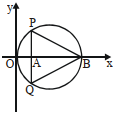
In the circle given below, let $OA =1$ unit, $OB =13$ unit and $PQ \perp OB$. Then, the area of the triangle $PQB$ (in square units) is
A tangent to the ellipse $\frac{x^2}{25}+\frac{y^2}{16}=1$ intersect the co-ordinate axes at $A$ and $B,$ then locus of circumcentre of triangle $AOB$ (where $O$ is origin) is
If $\text{f(x)}=\log\Big(\frac{1+\text{x}}{1-\text{x}}\Big)$ and $\text{g(x)}=\frac{3\text{x}+\text{x}^3}{1+3\text{x}^2},$ then $f(g(x))$ is equal to: