MCQ
The least stable ion is
- A$Li^-$
- ✓$Be^-$
- C$B^-$
- D$C^-$
The configuration of $Be$ is $1 s ^2\, 2 s ^2$. Adding one $e ^{-}$will disturb its stable fully filled configuration. So, it is the least stable among all.
The configuration of $B$ is $1 s ^2 \,2 s ^2\, 2 p ^1$. It does not have half-filled or fully filled configuration so adding one $e ^{-}$will not disturb its stable configuration.
The configuration of $C$ is $1 s ^2 \,2 s ^2\, 2 p ^2$. It does not have half-filled or fully filled configuration so adding one $e ^{-}$its configuration becoes $1 s ^2\, 2 s ^2 \,2 p ^3$ that it is a half-filled configuration and becomes stable.
Generate a complete, print-ready paper with questions like this in minutes — across 16+ boards, with answer keys.
($R$ is gas constant)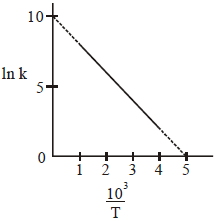
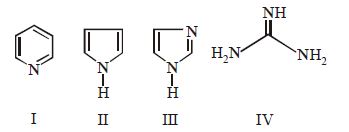
$2Al{(s)}+6HCl{(aq)} \rightarrow 2Al^{^{3+}}{(aq)}+6Cl^-{(aq)} +3H_2{(g)}$
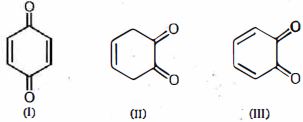
$Fe ^{2+} \rightarrow Fe ^{3+} + e ^{-} \quad E _{ Fe ^{3+} / Fe ^{2+}}=0.77 \,V$
$2 I ^{-} \rightarrow I _{2}+2 e ^{-} \quad E _{ I _{2} / I ^{-}}^{0}=0.54 \,V$
The standard electrode potential for the spontaneous reaction in the cell is $x \times 10^{-2} \,V 298$ $K$. The value of $x$ is .... (Nearest Integer)