MCQ
The least stable ion is
- A$Li^-$
- ✓$Be^-$
- C$B^-$
- D$C^-$
The configuration of $Be$ is $1 s ^2\, 2 s ^2$. Adding one $e ^{-}$will disturb its stable fully filled configuration. So, it is the least stable among all.
The configuration of $B$ is $1 s ^2 \,2 s ^2\, 2 p ^1$. It does not have half-filled or fully filled configuration so adding one $e ^{-}$will not disturb its stable configuration.
The configuration of $C$ is $1 s ^2 \,2 s ^2\, 2 p ^2$. It does not have half-filled or fully filled configuration so adding one $e ^{-}$its configuration becoes $1 s ^2\, 2 s ^2 \,2 p ^3$ that it is a half-filled configuration and becomes stable.
Generate a complete, print-ready paper with questions like this in minutes — across 16+ boards, with answer keys.
$(A)$ $C _6 H _5 OH$ and $C _6 H _5 COOH$
$(B)$ $C _6 H _5 COOH$ and $C _6 H _5 CH _2 OH$
$(C)$ $C _6 H _5 CH _2 OH$ and $C _6 H _5 OH$
$(D)$ $C _6 H _5 CH _2 OH$ and $C _6 H _5 CH _2 COOH$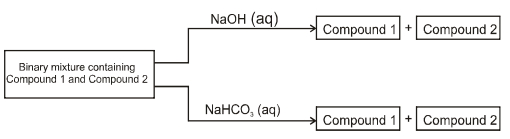
Statement $I$ : The boiling point of three isomeric pentanes follows the order
n-pentane $>$ isopentane $>$ neopentane
Statement $II$ : When branching increases, the molecule attains a shape of sphere. This results in smaller surface area for contact, due to which the intermolecular forces between the spherical molecules are weak, thereby lowering the boiling point.
In the light of the above statements, choose the most appropriate answer from the options given below: