Question
The length and breadth of a rectangular block are 25.2cm and 16.8cm, which have both been measured to an accuracy of 0.1cm. Find the area of the rectangular block.

Answer

Here, $\text{l}=(25.2\pm0.1)\text{cm}$ $\text{b}=(16.8\pm0.1)\text{cm}$ Area $=\text{l}\times\text{b}=25.2\times16.8=423.4\text{cm}^2$ As per the principle of error, $\frac{\Delta\text{A}}{\text{A}}=\pm\Big(\frac{\Delta\text{P}}{\text{P}}+\frac{\Delta\text{b}}{\text{b}}\Big)$ $\Rightarrow\frac{\Delta\text{A}}{423.4}=\pm\Big(\frac{0.1}{25.2}+\frac{0.1}{16.8}\Big)$ $\Rightarrow\Delta\text{A}=\pm\frac{423.4\times0.1\times42}{25.2\times16.8}$ $\Rightarrow\Delta\text{A}=\pm4.2\text{cm}^2$ Hence the area with error limit $=(423.4\pm4.2)\text{cm}^2$

Need a full question paper?

Generate a complete, print-ready paper with questions like this in minutes — across 16+ boards, with answer keys.
Start Generating Free

Similar questions

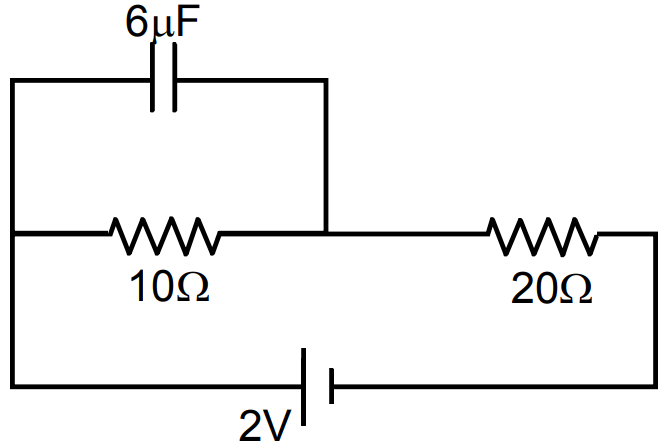
Find the charge on the capacitor shown in figure.
When two vectors $\vec{\text{A}}$ and $\vec{\text{B}}$ inclined at angle $\theta$ act on a body, the resultant is $(2\text{k}+1)\sqrt{\text{A}^2+\text{B}^2}.$ When the vectors are inclined at an angle $(90^\circ-\theta),$ the resultant is $(2\text{k}-1)\sqrt{\text{A}^2+\text{B}^2},$ prove that $\tan\theta=\frac{\text{k}-1}{\text{k}+1}.$
Radius of earth and Mars is about 6370km and 3440km respectively. An object weighs 200N on earth. What would it weigh on Mars? What is the acceleration due to gravity on Mars? Mars has a mass 0.11 of that of the Earth.
Two masses, one 'n' times as heavy as the other, have equal kinetic energy. What is the ratio of their momenta?
Is it possible to increase the temperature of a gas without adding heat to it? Explain.
A body placed on a rough inclined plane just begins to slide, when the slope of the plane equal to 1 in 4. Calculate the coefficient of friction.
A nonconducting sheet of large surface area and thickness d contains uniform charge distribution of density $\rho.$ Find the electric field at a point P inside the plate, at a distance x from the central plane. Draw a qualitative graph of E against x for 0 < x < d.
$0.75g$ of petroleum was burnt in a bomb calorimeter which contains $2kg$ of water and has a water equivalent $500$ grams. The rise in temp. was $3°C$. Determine the calorific value of petroleum.
Two equal and opposite forces act on a rigid body. Under what conditions will the body (i) rotate (ii) not rotate?
A jet airplane travelling at the speed of $500 km\ h^{–1}$ ejects its products of combustion at the speed of $1500km\ h^{–1}$ relative to the jet plane. What is the speed of the latter with respect to an observer on the ground?