MCQ
The limit of resolution of eye is approximately:
  • A
    $10$
  • $1′$
  • C
    $1\ mm$
  • D
    $1\ cm$

Answer

Correct option: B.
$1′$

The resolution of the human eye is the smallest object our eye can see. This is limited by the diffraction limit, which is approximated by the angular size ratio of the object's size versus the distance to the object.
The normal pupil size of a human eye is $4\ mm,$ which sets a minimum angular resolution of the eye and to able to see the small objects we bring them as close to our eyes as possible, but there is a minimum distance for comfortable viewing which is roughly at $25\ cm.$
But quoted figure for the smallest resolvable size is $0.1\ mm,$ showing that the diffraction limit is a crucial factor in visual resolving power.

Need a full question paper?

Generate a complete, print-ready paper with questions like this in minutes — across 16+ boards, with answer keys.
Start Generating Free

Similar questions

Lateral displacement of the emergent ray of light increases with:
The distance between the body centred atom and a corner atom in sodium (a = 4.225 Å) is
A capacitor is connected to a cell of emf E having some internal resistance r. The potential difference across the
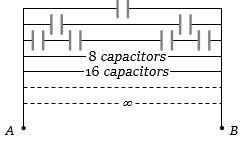
An infinite number of identical capacitors each of capacitance $1\,\mu F$ are connected as in adjoining figure. Then the equivalent capacitance between $A$ and $B$ is......$\mu F$
A copper wire is wound on a wooden frame, whose shape is that of an equilateral triangle. If the linear dimension of each side of the frame is increased by a factor of $3$, keeping the number of turns of the coil per unit length of the frame the same, then self inductance of the coil
Ratio between intensities of magnetic fields due to points situated on axial and non-axial positions of a small magnet at distance from it is:
A free electron is placed in the path of a plane electromagnetic wave. The electron will start moving:
The Fraunhoffer ‘diffraction’ pattern of a single slit is formed in the focal plane of a lens of focal length $1\,m$. The width of slit is $0.3\,mm$. If third minimum is formed at a distance of $5\,mm$ from central maximum, then wavelength of light will be......$\mathop A\limits^o $
A positively charged ball hangs from a silk thread. We put a positive test charge ${q_0}$ at a point and measure $F/{q_0}$, then it can be predicted that the electric field strength $E$
Given below are two statements :

Statement $I:$ If the Brewster's angle for the light propagating from air to glass is $\theta_{ B }$, then Brewster's angle for the light propagating from glass to air is $\frac{\pi}{2}-\theta_B$.

Statement $II:$ The Brewster's angle for the light propagating from glass to air is $\tan ^{-1}\left(\mu_{ g }\right)$ where $\mu_{ g }$ is the refractive index of glass.

In the light of the above statements, choose the correct answer from the options given below :