MCQ
The linear combination of atomic orbitals to form molecular orbitals takes place only when the combining atomic orbitals

$A$. have the same energy

$B$. have the minimum overlap

$C$. have same symmetry about the molecular axis

$D$. have different symmetry about the molecular axis

Choose the most appropriate from the options given below:

  • A
    $A, B, C$ only
  • $A$ and $C$ only
  • C
    $B, C, D$ only
  • D
    $B$ and $D$ only

Answer

Correct option: B.
$A$ and $C$ only
b
* Molecular orbital should have maximum overlap

* Symmetry about the molecular axis should be similar

Need a full question paper?

Generate a complete, print-ready paper with questions like this in minutes — across 16+ boards, with answer keys.

Start Generating Free

Similar questions

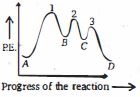
Energy profile diagram for an exothermic reaction, $A\xrightarrow{1}B\xrightarrow{2}C\xrightarrow{3}D,$ is given below.

The rate determining step of the reaction is

Which of the following benzene ring substituents is deactivating but orthopara directing ?
In Friedel-Crafts alkylation of aniline, one gets ....
The number of possible optical isomers for the complexes $\mathrm{MA}_{2} \mathrm{B}_{2}$ with $\mathrm{sp}^{3}$ and $\mathrm{dsp}^{2}$ hybridised metal atom, respectively, is

Note : $A$ and $B$ are unidentate neutral and unidentate monoanionic ligands, respectively

Plots showing the variation of the rate constant $(\mathrm{k})$ with temperature $(\mathrm{T})$ are given below. The plot that follows Arrhenius equation is
Given are $E^o$ values for some half reactions

$ {I_2} + 2{e^ - } \to \,2{I^ - }\,;\,\,{E^o}\, = \,\,0.54\,\,V $

$ MnO_4^ - \, + \,8{H^ + }\, + \,5{e^ - } \to \,M{n^{2 + }}\, + \,4{H_2}O\,;\,{E^{o\,}} = 1.52\,\,V $

$ F{e^{3 + }} + {e^ - } \to \,\,F{e^{2 + }}\,;\,\,{E^o}\, = \,\,0.77\,\,V $

$ S{n^{4 + }} + 2{e^ - } \to \,\,S{n^{2 + }}\,;\,\,{E^o}\, = \,\,0.1\,\,V $

 The strongest reducant and oxidant respectively are 

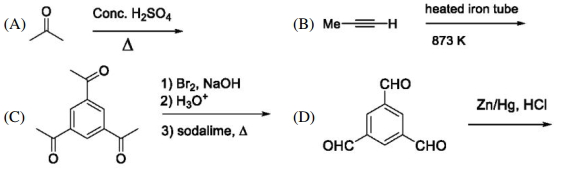
The reaction($s$) leading to the formation of $1,3,5-$trimethylbenzene is (are)

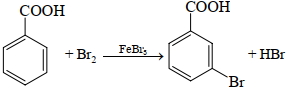
(image)

Consider the above reaction where $6.1 \,g$ of benzoic acid is used to get $7.8\, g$ of $m$ -bromo benzoic acid. The percentage yield of the product is ....... .

(Round off to the Nearest integer) [Given : Atomic masses : $C =12.0 \,u , H : 1.0\, u,O : 16.0 \,u , Br =80.0 \,u ]$

The smog is essentially caused by the presence of
The dissociation constant of a weak acid is $1 \times 10^{-4}.$ In order to prepare a buffer solution with a $pH = 5,$ the $[Salt]/[Acid]$ ratio should be