MCQ
The local maximum value of the function $f(x)=\left(\frac{2}{x}\right)^{x^{2}}, x>0$, is
  • A
    $(2 \sqrt{\mathrm{e}})^{\frac{1}{\mathrm{e}}}$
  • B
    $\left(\frac{4}{\sqrt{\mathrm{e}}}\right)^{\frac{\mathrm{e}}{4}}$
  • $(\mathrm{e})^{\frac{2}{\mathrm{e}}}$
  • D
    $1$

Answer

Correct option: C.
$(\mathrm{e})^{\frac{2}{\mathrm{e}}}$
c
$f(x)=\left(\frac{2}{x}\right)^{x^{2}} ; x>0$

$\ell n f(x)=x^{2}(\ell \ln 2-\ell n x)$

$f^{\prime}(x)=f(x)\{-x+(\ell n 2-\ell n x) 2 x\}$

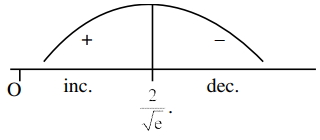
$f^{\prime}(x)=\underbrace{f(x)}_{+} \cdot \underbrace{x}_{+} \underbrace{(2 \ell n 2-2 \ell n x-1)}_{g(x)}$

$g(x)=2 \ell n^{2}-2 \ell n x-1$

$=\ell n \frac{4}{x^{2}}-1=0 \Rightarrow x=\frac{2}{\sqrt{e}}$

$\mathrm{LM}=\frac{2}{\sqrt{\mathrm{e}}}$

Local maximum value $=\left(\frac{2}{2 / \sqrt{\mathrm{e}}}\right)^{\frac{4}{\mathrm{e}}} \Rightarrow \mathrm{e}^{\frac{2}{\mathrm{e}}}$
Need a full question paper?

Generate a complete, print-ready paper with questions like this in minutes — across 16+ boards, with answer keys.

Start Generating Free

Similar questions

A particle moves in a straight line so that $s = \sqrt t $, then its acceleration is proportional to
The surface area of a balloon of spherical shape being inflated, increases at a constant rate. If initially, the radius of balloon is $3$ units and after $5$ seconds, it becomes $7$ units, then its radius after $9$ seconds is
The points $A(5,\, - 1,\,\,1)$; $B\,(7, - 4,\,7);$ $C(1,\, - 6,\,10)$ and $D( - 1, - 3,\,4)$ are vertices of a
Let $A = \left[ {\begin{array}{*{20}{c}}1&0&0\\5&2&0\\{ - 1}&6&1\end{array}} \right]$, then the adjoint of $ A $ is
Let $d$ be the distance of the point of intersection of the lines $\frac{x+6}{3}=\frac{y}{2}=\frac{z+1}{1} \quad$ and $\frac{x-7}{4}=\frac{y-9}{3}=\frac{z-4}{2}$ from the point $(7,8,9)$. Then $\mathrm{d}^2+6$ is equal to :
A continuously differentiable function $\phi (x)\,{\rm{in}}\,(0,\,\pi )$ satisfying $y' = 1 + {y^2},\,\,y(0) = 0 = y(\pi )$ is
For a real number $r$ let $[r]$ denote the largest integer less than or equal to $r$. Let $a > 1$ be a real number which is not an integer, and let $k$ be the smallest positive integer such that $\left[a^k\right] > [a]^k$. Then, which of the following statements is always true?
Observe that, at any instant, the minute and hour hands of a clock make two angles between them whose sum is $360^{\circ}$. At $6: 15$ the difference between these two angles is  $....^{\circ}$
If the roots of the equation ${x^2} + 2mx + {m^2} - 2m + 6 = 0$ are same, then the value of $m$ will be
If $f(x) = max(sinx, sin^{-1}(cosx))$, then