MCQ
The local maximum value of the function $f(x)=\left(\frac{2}{x}\right)^{x^{2}}, x>0$, is
  • A
    $(2 \sqrt{\mathrm{e}})^{\frac{1}{\mathrm{e}}}$
  • B
    $\left(\frac{4}{\sqrt{\mathrm{e}}}\right)^{\frac{\mathrm{e}}{4}}$
  • $(\mathrm{e})^{\frac{2}{\mathrm{e}}}$
  • D
    $1$

Answer

Correct option: C.
$(\mathrm{e})^{\frac{2}{\mathrm{e}}}$
c
$f(x)=\left(\frac{2}{x}\right)^{x^{2}} ; x>0$

$\ell n f(x)=x^{2}(\ell \ln 2-\ell n x)$

$f^{\prime}(x)=f(x)\{-x+(\ell n 2-\ell n x) 2 x\}$

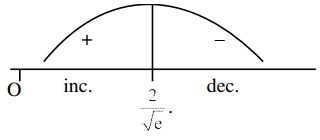
$f^{\prime}(x)=\underbrace{f(x)}_{+} \cdot \underbrace{x}_{+} \underbrace{(2 \ell n 2-2 \ell n x-1)}_{g(x)}$

$g(x)=2 \ell n^{2}-2 \ell n x-1$

$=\ell n \frac{4}{x^{2}}-1=0 \Rightarrow x=\frac{2}{\sqrt{e}}$

$\mathrm{LM}=\frac{2}{\sqrt{\mathrm{e}}}$

Local maximum value $=\left(\frac{2}{2 / \sqrt{\mathrm{e}}}\right)^{\frac{4}{\mathrm{e}}} \Rightarrow \mathrm{e}^{\frac{2}{\mathrm{e}}}$

Need a full question paper?

Generate a complete, print-ready paper with questions like this in minutes — across 16+ boards, with answer keys.

Start Generating Free

Similar questions

A fair coin is tossed 99 times. If X is the number of times head appears, then P(X = r) is maximum when r is:
Find the minor of element $6$ in the determinant $\Delta=\left|\begin{array}{lll}1 & 2 & 3 \\ 4 & 5 & 6 \\ 7 & 8 & 9\end{array}\right|$
$If\  y = x^4 - 10$ and $if\  x$ changes from $2$ to $1.99,$ what is the change in $y:$
Let $f(x) = \sin x$ and $g(x) = \ln |x|$. If the ranges of the composite functions $fog$ and $gof$ are ${R_1}$ and ${R_2}$ respectively, then
If a continuous $f$ defined on the real line $R$, assumes positive and negative values in $R$ then the equation $f(x)=0$ has a root in $R$. For example, if it is known that a continuous function $f$ on $R$ is positive at some point and its minimum values is negative then the equation $f(x)=0$ has a root in $R$.

Consider $f(x)=k e^x-x$ for all real $x$ where $k$ is a real constant.

$1.$  The line $\mathrm{y}=\mathrm{x}$ meets $\mathrm{y}=k e^{\mathrm{x}}$ for $\mathrm{k} \leq 0$ at

$(A)$ no point $(B)$ one point

$(C)$ two points $(D)$ more than two points

$2.$  The positive value of $\mathrm{k}$ for which $\mathrm{ke}^{\mathrm{x}}-\mathrm{x}=0$ has only one root is

$(A)$ $1 / \mathrm{e}$ $(B)$ $1$ $(C)$ e $(D)$ $\log _e 2$

$3.$  For $k>0$, the set of all values of $k$ for which $k e^x-x=0$ has two distinct roots is

$(A)$ $\left(0, \frac{1}{\mathrm{e}}\right)$ $(B)$ $\left(\frac{1}{\mathrm{e}}, 1\right)$ $(C)$ $\left(\frac{1}{e}, \infty\right)$ $(D)$ $(0,1)$

Give the answer question $1,2$ and $3.$
Evaluate the determinant $\Delta=\left|\begin{array}{rrr}1 & 2 & 4 \\ -1 & 3 & 0 \\ 4 & 1 & 0\end{array}\right|$
Let $P(x)=a_0+a_1 x^2+a_2 x^4+\ldots+a_n x^{2 n}$ with all $a_i>0, i=0,1,2, \ldots, n$. Then $P(x)$ has
Let $ABCD$ is a parallelogram where $\overrightarrow {AB}  = \overrightarrow a ,\,\overrightarrow {AD}  = \overrightarrow b ,\,\left| {\overrightarrow a } \right| = \left| {\overrightarrow b } \right| = 2$ and $\left| {\overrightarrow a  \times \overrightarrow b } \right| + \overrightarrow a  \cdot \overrightarrow b  = \sqrt 2 \,\left| {\overrightarrow a } \right|\left| {\overrightarrow b } \right|\,\left( {\overrightarrow a  \cdot \overrightarrow b \, > \,0} \right),$ then area of this parallelogram, is (in square units)-
If the matrix $\begin{bmatrix}1 &\text{amp;3}& \text{amp}\lambda+2 \\2& \text{amp;4}&\text{amp;8} \\3&\text{amp;5}&\text{amp;}10 \end{bmatrix}$ is singular, then $\lambda=$
If $A$ is a $3 \times 3$ matrix and det$(3A) = k($det $A),$ then $k =$