MCQ
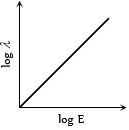
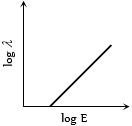
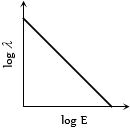
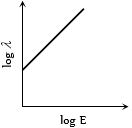
The $log-log$ graph between the energy $E$ of an electron and its de-Broglie wavelength $\lambda $ will be
  • A

  • B


  • D

Answer

Correct option: C.

c
(c) $\lambda = \frac{h}{{\sqrt {2mE} }} = \frac{h}{{\sqrt {2m} }} \cdot \frac{1}{{\sqrt E }}$. 

Taking $log$ of both sides $\log \lambda = \log \frac{h}{{\sqrt 2 m}} + \log \frac{1}{{\sqrt E }}$

$⇒$ $\log \lambda = \log \frac{h}{{\sqrt 2 m}} - \frac{1}{2}\log E$

$ \Rightarrow \log \lambda = - \frac{1}{2}\log E + \log \frac{h}{{\sqrt {2m} }}$

This is the equation of straight line having slope $(-1/2)$ and positive intercept on log $\lambda$axis.

Need a full question paper?

Generate a complete, print-ready paper with questions like this in minutes — across 16+ boards, with answer keys.
Start Generating Free

Similar questions

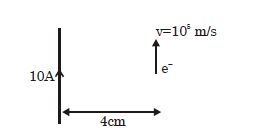
An $e^-$ is moving parallel to a long current carrying wire as shown. Force on electron is
A transverse harmonic wave on a string is given by $y(x, t)=5 \sin (6 t+0.003 x)$ where $x$ and $y$ are in $cm$ and $t$ in $sec$. The wave velocity is $...........\,ms ^{-1}$.
Two electric bulbs rated ${P_1}\,watt$  $V\, volts$ and ${P_2}\, watt$ $V\, volts$ are connected in parallel and $V\, volts$ are applied to it. The total power will be
Two bodies of masses $2\,kg$ and $4\,kg$ are moving with velocities $2\,m/s$ and $10\,m/s$ respectively towards each other due to mutual gravitational attraction. ....... $m/s$ is the velocity of their centre of mass (Bodies are at rest initially)
A black body is at a temperature of $500 \;K$, it emits energy at a rate which is proportional to
The tension of a stretched string is increased by $69\%$. In order to keep its frequency of vibration constant, its length must be increased by ..... $\%$
If the critical angle for total internal reflection from a medium to vacuum is $30^o $, the velocity of light in the medium is
$X$ different wavelengths may be observed in the spectrum from a hydrogen sample if the atoms are exited to states with principal quantum number ${n}=6$ ? The value of ${X}$ is ..... .
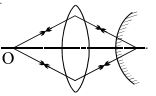
$A$ object is placed at a distance of $15\,cm$ from a convex lens of focal length $10\,cm$. On the other side of the lens, a convex mirror is placed at its focus such that the image formed by the combination coincides with the object itself. The focal length of the convex mirror is.....$cm$
A copper disc of radius $0.1\, m$ rotates about its centre with $10$ revolutions per second in a uniform magnetic field of $0.1$ Tesla. The emf induced across the radius of the disc is