MCQ
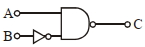
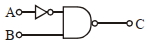
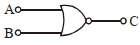
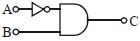
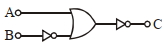
The logic circuit shown above is equivalent to :
  • A

  • B

  • C


Answer

Correct option: D.

d
Truth table of the given gate :

$\begin{array}{lll}\text { A } & \text { B } & \text { C } \\ 0 & 0 & 0 \\ 0 & 1 & 1 \\ 1 & 0 & 0 \\ 1 & 1 & 0\end{array}$

Truth table of option $(1)$

$\begin{array}{lll}\text { A } & \text { B } & \text { C } \\ 0 & 0 & 1 \\ 0 & 1 & 1 \\ 1 & 0 & 0 \\ 1 & 1 & 1\end{array}$

Truth table of option $(2)$

$\begin{array}{lll}\text { A } & \text { B } & \text { C } \\ 0 & 0 & 1 \\ 0 & 1 & 0 \\ 1 & 0 & 1 \\ 1 & 1 & 1\end{array}$

Truth table of option $(3)$

$\begin{array}{lll}\text { A } & \text { B } & \text { C } \\ 0 & 0 & 1 \\ 0 & 1 & 0 \\ 1 & 0 & 0 \\ 1 & 1 & 0\end{array}$

Truth table of option $(4)$

$\begin{array}{lll}\text { A } & \text { B } & \text { C } \\ 0 & 0 & 0 \\ 0 & 1 & 1 \\ 1 & 0 & 0 \\ 1 & 1 & 0\end{array}$

Since option $(1)$ has same truth table.

Need a full question paper?

Generate a complete, print-ready paper with questions like this in minutes — across 16+ boards, with answer keys.
Start Generating Free

Similar questions

Four electric charges $+q,+q, -q$ and $-q$ are placed at the comers of a square of side $2L$ (see figure). The electric potential at point $A,$ midway between the two charges $+q$ and $+q,$ is
Three long, straight parallel wires carrying current, are arranged as shown in figure. The force experienced by a $25\, cm$ length of wire $C$ is
The idea of secondary wavelets for the propagation of a wave was first given by
The objective glass of a telescope is an achromat of focal length $90\,cm$ . The magnitude of dispersive power of the two lenses are $0.024$ and $0.036$ . The focal lengths are 
A wire of resistance R is divided in 10 equal parts. These parts are connected in parallel, the equivalent resistance of such connection will be
Two point charges $A$ and $B$ of magnitude $+8 \times 10^{-6}\,C$ and $-8 \times 10^{-6}\,C$ respectively are placed at a distance $d$ apart. The electric field at the middle point $O$ between the charges is $6.4 \times 10^{4}\,NC ^{-1}$. The distance ' $d$ ' between the point charges $A$ and $B$ is..............$m$
A proton and an alpha particle both enter a region of uniform magnetic field $B,$ moving at right angles to field $B$. If the radius of circular orbits for both the particles is equal and the kinetic energy acquired by proton is $1 \ MeV$ the energy acquired by the alpha particle will be:
The concept of stationary orbits was proposed by
A uniform but time-varying magnetic field $B(t)$ exists in a circular region of radius $a$ and is directed into the plane of the paper, as shown. The magnitude of the induced electric field at point $P$ at a distance $r$ from the centre of the circular region
'Albedo' is