MCQ
The lower surface of a cube is fixed. On its upper surface, force is applied at an angle of $30°$ from its surface. The change will be of the type
  • A
    Shape
  • B
    Size
  • C
    None
  • Shape and size

Answer

Correct option: D.
Shape and size
d
(d) There will be both shear stress and normal stress.

Need a full question paper?

Generate a complete, print-ready paper with questions like this in minutes — across 16+ boards, with answer keys.

Start Generating Free

Similar questions

Three identical thin rods each of mass $m$ and length $l$ are placed along $x, y$ and $z$ -axis respectively they are placed such that, one end of each rod is at origin $O$ . Then moment of inertia of this system about $z -$ axis is
The adiabatic Bulk modulus of a diatomic gas at atmospheric pressure is
A spectrometer gives the following reading when used to measure the angle of a prism. 

Main scale reading : $58.5$ degree

Vernier scale reading : $09$ divisions

Given that $1$ division on main scale corresponds to $0 .5$ degree. Total divisions on the Vernier scale is $30$ and match with $29$ divisions of the main scale. The angle of the prism from the above data ....... $degree$
The maximum speed of a particle executing $S.H.M.$ is $1\,m/s$ and its maximum acceleration is $1.57\,m/se{c^2}$. The time period of the particle will be .... $\sec$
A wooden cube (density of wood $'d'$ ) of side $'l'$ floats in a liquid of density $'\rho '$ with its upper and lower surfaces horizontal. If the cube is pushed slightly down and released, it performs simple harmonic motion of period $'T'$. Then, $'T'$ is equal to
A particle is projected from a horizontal plane ($x-z$ plane) such that its velocity vector at time t is given by $\vec V = a\hat i + (b - ct)\hat j$ Its range on the horizontal plane is given by
In a plane progressive harmonic wave, particle speed is always less than the wave speed, if
To a person, going eastward in a car with a velocity of $25\, km/hr$, a train appears to move towards north with a velocity of $25\sqrt 3 $ $km/hr$. The actual velocity of the train will be..........$km/hr$
In an isothermal process $2$ water drops of radius $1 \,mm$ are combined to form a bigger drop. Find the energy (in $\mu J$) change in this process if $T =0.1\, N / m$ 
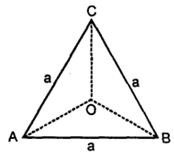
$ABC$ is an equilateral triangle. Length of each side is $a$ and centroid is point $O$. Find If $|\overrightarrow{A B}+\overrightarrow{B C}+\overrightarrow{A C}|=n a$ then $n =$ ?