Question
The magnetic field in a plane electromagnetic wave is given by $\text{B}=(200\mu\text{T})\sin\Big[\big(4.0\times10^{15}\text{s}^{-1}\big)\Big(\text{t}-\frac{\text{x}}{\text{c}}\Big)\Big]$ Find the maximum electric field and the average energy density corresponding to the electric field.
Answer

$\text{B}=(200\mu\text{T})\sin\Big[\big(4.0\times10^{15}\text{s}^{-1}\big)\Big(\text{t}-\frac{\text{x}}{\text{c}}\Big)\Big]$$\text{B}_0=200\mu\text{T}$
$\text{E}_0=\text{C}\times\text{B}_0$
$\text{E}_0=200\times10^{-6}\times3\times10^{8}$
$\text{E}_0=6\times10^4$
Average energy density $=\frac{1}{2\mu_0}\text{B}_0^2=\frac{\big(200\times10^{-6}\big)^2}{2\times4\pi\times10^{-7}}$
$=\frac{4\times10^{-8}}{8\pi\times10^{-7}}=\frac{1}{20\pi}=0.0159=0.016$

Need a full question paper?

Generate a complete, print-ready paper with questions like this in minutes — across 16+ boards, with answer keys.

Start Generating Free

Similar questions

  1. For a given a.c.,$\text{i} = \text{i}_{m}\sin\omega\text{t},$ show that the average power dissipated in a resistor R over a complete cycle is $\frac{1}{2}\text{i}_{m}^{2}\text{R}.$
  2. A light bulb is rated at 100 W for a 220 V a.c. supply. Calculate the resistance of the bulb.
A square loop of side $10 \ cm$ and resistance $0.5 \Omega$ is placed vertically in the east $-$ west plane. A uniform magnetic field of $0.10 T$ is set up across the plane in the north $-$ east direction. The magnetic field is decreased to zero in $0.70 s$ at a steady rate. Determine the magnitudes of induced emf and current during this time $-$ interval.
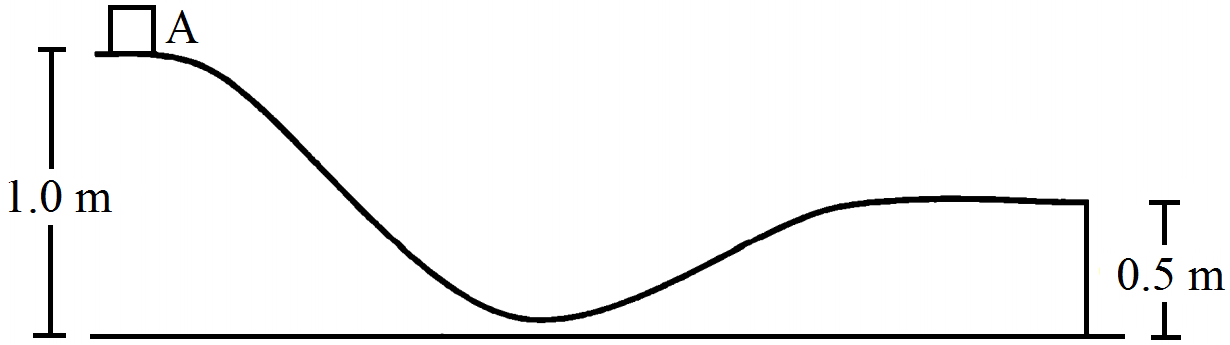
Figure shows a particle sliding on a frictionless track which terminates in a straight horizontal section. If the particle starts slipping from the point A, how far away from the track will the particle hit the ground?
A circular loop of radius r carries a current i. How should a long, straight wire carrying a current 4i be placed in the plane of the circle so that the magnetic field at the centre becomes zero?
A ball falls on the ground from a height of 2.0m and rebounds up to a height of 1.5m. Find the coefficient of restitution.
What is the advantage of using thick metallic strips to join wires in a potentiometer?
A rod is inserted as the core in the current-carrying solenoid of the previous problem.
  1. What is the magnetic intensity H at the centre?
  2. If the magnetization I of the core is found to be 0.12Nm, find the susceptibility of the material of the rod.
  3. Is the material paramagnetic, diamagnetic or ferromagnetic?
A metal sphere of radius R is charged to a potential V:
  1. Find the electrostatic energy stored in the electric field within a concentric sphere of radius 2R.
  2. Show that the electrostatic field energy stored outside the sphere of radius 2R equals that stored within it.
  1. A rod of length l is moved horizontally with a uniform velocity ‘v’ in a direction perpendicular to its length through a region in which a uniform magnetic field is acting vertically downward. Derive the expression for the emf induced across the ends of the rod.
  2. How does one understand this motional emf by invoking the Lorentz force acting on the free charge carriers of the conductor? Explain.
  1. Show, with the help of a diagram, how unpolarised sunlight gets polarised due to scattering.
  2. Two polaroids $P_1$ and $P_2$ are placed with their pass axes perpendicular to each other. Unpolarised light of intensity $I_0$ is incident on $P_1$. A third polaroid $P_3$ is kept in between $P_1$ and $P_2$ such that its pass axis makes an angle of $45^{\circ}$ with that of P 1 . Determine the intensity of light transmitted through $\mathrm{P}_1, \mathrm{P}_2$ and $\mathrm{P}_3$.