Question
The magnetic field lines prefer to pass through iron than air. Explain why?

Answer

The magnetic field lines prefer to pass through iron than air because the permeability of iron is much larger than air.

Need a full question paper?

Generate a complete, print-ready paper with questions like this in minutes — across 16+ boards, with answer keys.
Start Generating Free

Similar questions

Write two important limitations of Rutherford nuclear model of the atom.
Two capacitors of capacitance $3 \mu F$ and 4 $\mu F$ are charged separately from a 6 V battery. When the battery is removed, they get connected to each other. In which the negative plate of one capacitor is connected to the positive plate of the other. Calculate the total final energy.
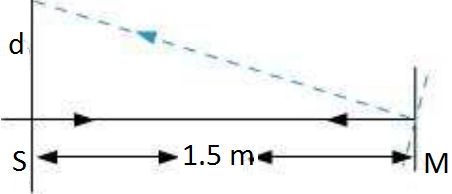
Light incident normally on a plane mirror attached to a galvanometer coil retraces backwards. A current in the coil produces a deflection of 3.5° of the mirror. What is the displacement of the reflected spot of light on a screen placed 1.5 m away?

An alpha particle is projected vertically upward with a speed of 3.0 × 10⁴km s-1 in a region where a magnetic field of magnitude 1.0T exists in the direction south to north. Find the magnetic force that acts on the α-particle.
A barometer is constructed with its tube having radius 1.0mm. Assume that the surface of mercury in the tube is spherical in shape. If the atmospheric pressure is equal to 76cm of mercury, what will be the height raised in the barometer tube. The contact angle of mercury with glass = 135º and surface tension of mercury = 0.465N/m. Density of mercury = 13600kg/m3.
The charge on a proton is +1.6 × 10-19C and that on an electron is -1.6 × 10-19C. Does it mean that the electron has a charge 3.2 × 10-19C less than the charge of a proton?
In 1959 Lyttleton and Bondi suggested that the expansion of the Universe could be explained if matter carried a net charge. Suppose that the Universe is made up of hydrogen atoms with a number density N, which is maintained a constant. Let the charge on the proton be: ep = -(1 + y)e where e is the electronic charge.
Show that the velocity of expansion is proportional to the distance from the centre.
The refractive index of a material changes by 0.014 as the colour of the light changes from red to violet. A rectangular slab of height 2.00cm made of this material is placed on a newspaper. When viewed normally in yellow light, the letters appear 1.32cm below the top surface of the slab. Calculate the dispersive power of the material.
Why are elemental dopants for Silicon or Germanium usually chosen from group XIII or group XV?
Define the term ‘power loss’ in a conductor of resistance R carrying a current I. In what form does this power loss appear? Show that to minimise the power loss in the transmission cables connecting the power stations to homes; it is necessary to have the connecting wires carrying current at enormous high values of voltage.