MCQ
The magnetic force required to demagnetise the material is:
  • A
    Retentivity.
  • Coercivity.
  • C
    Energy loss.
  • D
    Hysterisis.

Answer

Correct option: B.
Coercivity.

Coercivity is the magnetic force required to demagnetise the material.

Need a full question paper?

Generate a complete, print-ready paper with questions like this in minutes — across 16+ boards, with answer keys.
Start Generating Free

Similar questions

$\sigma_1$ and $\sigma_1$ are the electrical conductivities of Ge and Na respectively. If these substances are heated, then(a)(b) (c) (d)
The de-Broglie wavelength associated with the particle of mass $m$ moving with velocity $v$ is
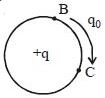
A circle of radius $R$ is drawn with charge $+ q$ at the centre. A charge $q_0$ is brought from point $B$ to $C$, then work done is
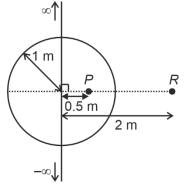
An infinitely long thin wire, having a uniform charge density per unit length of $5 nC / m$, is passing through a spherical shell of radius $1 m$, as shown in the figure. A $10 nC$ charge is distributed uniformly over the spherical shell. If the configuration of the charges remains static, the magnitude of the potential difference between points $P$ and $R$, in Volt, is. . . .

[Given: In SI units $\frac{1}{4 \pi \in_0}=9 \times 10^9, \ln 2=0.7$. Ignore the area pierced by the wire.]
A point charge q is rotated along a circle in the electric field generated by another point charge $Q$. The work done by the electric field on the roatating charge in one complete revolution is:
A sinusoidal wave $y ( t )=40 \sin \left(10 \times 10^{6} \pi t \right)$ is amplitude modulated by another sinusoidal wave $x ( t )=20 \sin (1000 \pi t )$. The amplitude of minimum frequency component of modulated signal is ...........
Light rays falls on a plane mirror and forms a real image, so the incident rays are
Potential difference in ac circuit is $V =20 \sin \omega t$ and current flowing is $I =5 \cos \omega t$, then power dissipated in watts is :
The sun revolves around the galaxy with a speed of $250 \mathrm{~km} / \mathrm{sec}$ and it's radius is $3 \times 10^4$ light year. The mass of the milky way is
An air bubble in sphere having $4 \,cm$ diameter appears $1 \,cm$ from surface nearest to eye when looked along diameter. If $_a\mu_g = 1.5$, the distance of bubble from refracting surface is.....$cm$