MCQ
The magnetic susceptibility is negative for
  • A
    Paramagnetic materials
  • Diamagnetic materials
  • C
    Ferromagnetic materials
  • D
    Paramagnetic and ferromagnetic materials

Answer

Correct option: B.
Diamagnetic materials
 Diamagnetic materials

Need a full question paper?

Generate a complete, print-ready paper with questions like this in minutes — across 16+ boards, with answer keys.
Start Generating Free

Similar questions

In the Davisson and Germer experiment, the velocity of electrons emitted from the electron gun can be increased by
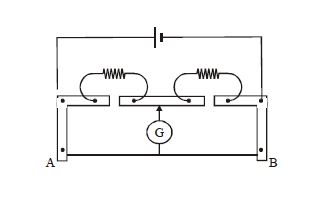
A meter bridge set up as shown to determine end correction at $A$ and $B$. When a resistance of $15\ \Omega$ is used in left gap and of $20\ \Omega$ in right gap, then null point comes at a distance $42\ cm$ from $A$. When these resistances are interchanged null point comes at a distance $57\ cm$ from $A$. Values of end corrections are
A metallic particle having no net charge is placed near a finite metal plate carrying a positive charge. The electric force on the particle will be:
A parallel beam of fast moving electrons is incident normally on a narrow slit. A screen is placed at a large distance from the slit. If the speed of the electrons is increased, which of the following statement is $CORRECT$ ?
Threshold frequency is the frequency :
Which of the following wavelength falls in $X-$ray region
Two points $A$ and $B$ are situated at a distance $x$ and $2x$ respectively from the nearer pole of a magnet $2\,cm$ long. The ratio of magnetic field at $A$ and $B$ is
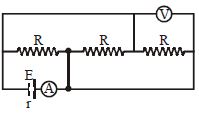
In the following circuit diagram, $E = 4\,V, r = 1\,\Omega$ and $R = 45\, \Omega$, then  reading of the ammeter $A$ will be
Two identical charged spheres suspended from a common point by two massless strings of lengths $l,$ are initially at a distance $d\;(d < < l)$ apart because of their mutual repulsion. The charges begin to leak from both the spheres at a constant rate. As a result, the spheres approach each other with a velocity $v.$ Then $v$ varies as a function of the distance $x$ between the spheres, as 
${O^{ + + }},\;{C^ + },\;H{e^{ + + }}$ and ${H^ + }$ ions are projected on the photographic plate with same velocity in a mass spectrograph. Which one will strike farthest