Question
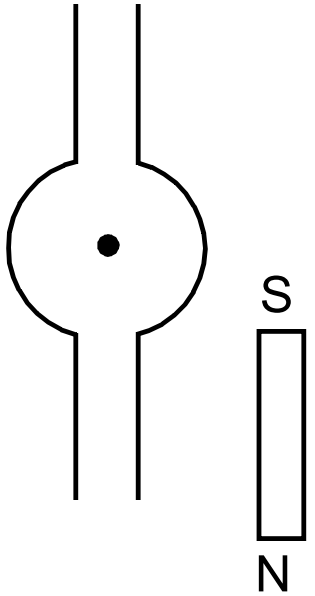
The magnetometer of the previous problem is used with the same magnet in $\tan-\text{B}$ position. Where should the magnet be placed to produce a 37° deflection of the needle?
Answer

Given $\frac{\text{M}}{\text{B}_\text{H}}=40\text{A-m}^2/\text{T}$
Since the magnet is short ‘ℓ’ can be neglected
So, $\frac{\text{M}}{\text{B}_\text{H}}=\frac{4\pi}{\mu_0}\times\frac{\text{d}^3}{2}=40$
$\Rightarrow\text{d}^3=\frac{40\times4\pi\times10^{-7}\times2}{4\pi}=8\times10^{-6}$
$\Rightarrow\text{d}=2\times10^{-2}\text{m}=2\text{cm}$
with the northpole pointing towards south.

Need a full question paper?

Generate a complete, print-ready paper with questions like this in minutes — across 16+ boards, with answer keys.
Start Generating Free

Similar questions

A uniformly charged conducting sphere of 2.4 m diameter has a surface charge density of$80.0 \mu C / m ^2$.
(a) Find the charge on the sphere.
(b) What is the total electric flux leaving the sur-face of the sphere?
A transformer is essentially an a.c. device. It cannot work on d.c. It changes altemating voltages or currents. It does not affect the frequency of a.c. It is based on the phenomenon of mutual induction. A transformer essentially consists of two coils of insulated copper wire having different number of tums and wound on the same soft iron core.
The number of turns in the primary and secondary coils of an ideal transfonner are 2000 and 50 respectively. The primary coil is connected to a main supply of 120V and secondary coil is connected to a bulb of resistance $0.6\Omega.$
  1. The value of voltage across the secondary coil is:
  1. 5V
  2. 2V
  3. 3V
  4. 10V
  1. The value of current in the bulb is:
  1. 7A
  2. 15A
  3. 3A
  4. 5A
  1. The value of current in primary coil is:
  1. 0.125A
  2. 2.52A
  3. 1.51A
  4. 3.52A
  1. Power in primary coil is:
  1. 20W
  2. 5W
  3. 10W
  4. 15W
  1. Power in secondary coil is:
  1. 15W
  2. 20W
  3. 7W
  4. 8W
While watering a distant plant, a gardener partially water than in fresh closes the exit hole of the pipe by putting his finger on it. Explain why this results in the water stream goirig to a larger distance.
The radio and TV programmes, telecast at the studio, reach our antenna by wave motion. Is it a mechanical wave or nonmechanical?
In the derivation of P1 - P2 = Pgz, it was assumed that the liquid is incompressible. Why will this equation not be strictly valid for a compressible liquid?
 For the past some time, Aarti had been observing some erratic body movement, unsteadiness and lack of coordination in the activities of her sister Radha, who also used to complain of severe headache occasionally. Aarti suggested to her parents to get a medical check-up of Radha. The doctor thoroughly examined Radha and diagnosed that she has a brain tumour.
  1. What, according to you, are the values displayed by Aarti?
  2. How can radioisotopes help a doctor to diagnose brain tumour? 
In a TV picture tube electrons are ejected from the cathode with negligible speed and reach a velocity of 5 × 10⁶m/s in travelling one centimeter. Assuming straight line motion, find the constant force exerted on the electron. The mass of the electron is 9.1 × 10⁻³¹kg.
Derive an expression for the magnetic field at any point on the axis of a current carrying loop from Bio-Savart's law. Draw the necessry fig.
When light of sufficiently high frequency is incident on a metallic surface, electrons are emitted from the metallic surface. TI1is phenomenon is called photoelectric emission. Kinetic energy of the emitted photoelectrons depends on the wavelength of incident tight and is independent of the intensity of light. Number of emitted photoelectrons depends on intensity. $(\text{h}\upsilon-\phi)$ is the maximum kinetic energy of emitted photoelectrons (where $\phi$ is the work function of metallic surface). Reverse effect of photo emission produces X-ray. X-ray is not deflected by electric and magnetic fields. Wavelength of a continuous X-ray depends on potential difference across the tube. Wavelength of characteristic X-ray depends on the atomic number.
  1. Einstein's photoelectric equation is:
  1. $\text{E}_\text{max}=\text{h}\upsilon-\phi$
  2. $\text{E}=\text{mc}^2$
  3. $\text{E}^2=\text{p}^2\text{c}^2+\text{m}_0^2\text{c}^4$
  4. $\text{E}=\frac{1}{2}\text{mv}^2$
  1. Light of wavelength $\lambda$ which is less than threshold wavelength is incident on a photosensitive material. If incident wavelength is decreased so that emitted photoelectrons are moving with some velocity then stopping potential will:
  1. Increase.
  2. Decrease.
  3. Be zero.
  4. Become exactly half.
  1. When ultraviolet rays incident on metal plate then photoelectric effect does not occur, it occur by incident of:
  1. Infrared rays
  2. X-rays
  3. Radio wave
  4. Micro wave
  1. If frequency $(\upsilon>\upsilon_0)$ of incident light becomes n times the initial frequency $(\upsilon)$, then K.E. of the emitted photoelectrons becomes ($\upsilon_0$ threshold frequency).
  1. N times of the initial kinetic energy.
  2. More than n times of the initial kinetic energy.
  3. Less than n times of the initial kinetic energy.
  4. Kinetic energy of the emitted photoelectrons remains unchanged.
  1. A monochromatic light is used in a photoelectric experiment. The stopping potential.
  1. Is related to the mean wavelength.
  2. Is related to the shortest wavelength.
  3. Is not related to the minimum kinetic energy of emitted photoelectrons.
  4. Intensity of incident tight.