The magnitude of the centripetal force acting on a body of mass $m$ executing uniform motion in a circle of radius $r$ with speed $v$ is
Easy
Download our app for free and get started
(b) $\mathrm{P}=\mathrm{mv}$
SO $\mathrm{V}=\mathrm{P} / \mathrm{m}$
so radial force is $=\mathrm{mv}^ 2 / \mathrm{r}$

Download our appand get started for free
Experience the future of education. Simply download our apps or reach out to us for more information. Let's shape the future of learning together!No signup needed.*
Similar Questions
- 1A lift is moving downwards with an acceleration equal to acceleration due to gravity. $A$ body of mass $M$ kept on the floor of the lift is pulled horizontally. If the coefficient of friction is $\mu $, if the lift is moving upwards with a uniform velocity, then the frictional resistance offered by the body isView Solution
- 2On the horizontal surface of a truck a block of mass $1 \;kg$ is placed $(\mu=0.6)$ and truck is moving with acceleration $5\; m / sec ^2$ then the frictional force on the block will beView Solution
- 3A body takes just twice the time as long to slide down a plane inclined at $30^o$ to the horizontal as if the plane were frictionless. The coefficient of friction between the body and the plane isView Solution
- 4View SolutionTo avoid slipping while walking on ice, one should take smaller steps because of the
- 5The normal reaction $'{N}^{\prime}$ for a vehicle of $800\, {kg}$ mass, negotiating a turn on a $30^{\circ}$ banked road at maximum possible speed without skidding is $...\,\times 10^{3}\, {kg} {m} / {s}^{2}$ [Given $\left.\cos 30^{\circ}=0.87, \mu_{{s}}=0.2\right]$View Solution
- 6Find the maximum velocity for skidding for a car moved on a circular track of radius $100\, m$. The coefficient of friction between the road and tyre is $0.2$ ....... $m/s$View Solution
- 7A block of mass $10\, kg$ is placed on an inclined plane. When the angle of inclination is $30°$, the block just begins to slide down the plane. The force of static friction is ....... $kg\, wt$View Solution
- 8A car is moving on a plane inclined at $30^{\circ}$ to the horizontal with an acceleration of $10\, {ms}^{-2}$ parallel to the plane upward. A bob is suspended by a string from the roof of the car.The angle in degrees which the string makes with the vertical is ...... . (Take ${g}=10\, {ms}^{-2}$ )View Solution
- 9A body of mass $2 \,kg$ is kept by pressing to a vertical wall by a force of $100\, N$. The coefficient of friction between wall and body is $0.3.$ Then the frictional force is equal to ........ $N$View Solution
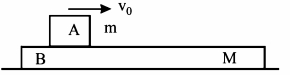
- 10The masses of blocks A and B are $m$ and $M$ respectively. Between $A$ and $B$, there is a constant frictional force $F$ and $B$ can slide on a smooth horizontal surface. A is set in motion with velocity while $B$ is at rest. What is the distance moved by A relative to $B$ before they move with the same velocity?View Solution