MCQ
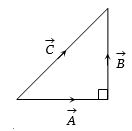
The magnitudes of vectors $\vec A,\,\vec B$ and $\vec C$ are $3, 4$ and $5$ units respectively. If $\vec A + \vec B = \vec C$, the angle between $\vec A$ and $\vec B$ is
  • $\frac{\pi }{2}$
  • B
    ${\cos ^{ - 1}}(0.6)$
  • C
    ${\tan ^{ - 1}}\left( {\frac{7}{5}} \right)$
  • D
    $\frac{\pi }{4}$

Answer

Correct option: A.
$\frac{\pi }{2}$
a
(a) $C = \sqrt {{A^2} + {B^2}} $

=$\sqrt {{3^2} + {4^2}} = 5$

$\therefore $ Angle between $\overrightarrow A $ and $\overrightarrow B $ is $\frac{\pi }{2}$

Need a full question paper?

Generate a complete, print-ready paper with questions like this in minutes — across 16+ boards, with answer keys.

Start Generating Free

Similar questions

A simple pendulum executing $S.H.M.$ is falling freely along with the support. Then
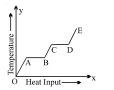
A solid material is supplied with heat at a constant rate. The temperature of material is changing with heat input as shown in the figure. What does slope $DE$ represent.
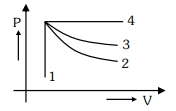
An ideal gas undergoes four different processes from the same initial state as shown in the figure below. Those processes are adiabatic, isothermal, isobaric and isochoric. The curve which represents the adiabatic process among $1,2,3$ and $4$ is
When a massive body suffers an elastic collision with a stationary light body, then massive body approximately comes to rest and light body-
Aball is thrown from a point on ground at some angle of projection. At the same time a bird starts from a point directly above this point of projection at a height $h$ horizontally with speed $u$. Given that in its flight ball just touches the bird at one point. Find the distance on ground where ball strikes
A cylindrical solid of mass $M$ has raidus $R$ and length $L.$ Its moment of inertia about a generator:
The initial mass of a rocket is $1000\, {kg} .$ Calculate at what rate the fuel (In ${kg} {s}^{-1}$) should be burnt so that the rocket is given an acceleration of $20 \,{ms}^{-2}$. The gases come out at a relative speed of $500\, {ms}^{-1}$ with respect to the rocket : [Use $ g = 10\, {m} / {s}^{2}$ ]
An electrically maintained tuning fork vibrates with constant frequency and constant amplitude. If the temperature of the surrounding air increases but pressure remains constant, the sound produced will have:
  1. Larger wavelength.
  2. Larger frequency.
  3. Larger velocity.
  4. Larger time period.
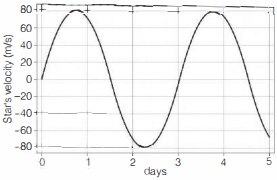
A star of mass $M$ (equal to the solar mass) with a planet (much smaller than the star) revolves around the star in a circular orbit. The velocity of the star with respect to the centre of mass of the star-planet system is shown below. The radius of the planet's orbit is closest to .......... $AU$ $(1 \,AU =$ Earth-Sun distance)
A uniform cube is subjected to volume compression. If each side is decreased by $1\%,$ then bulk strain is