MCQ
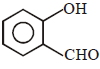
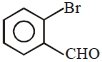
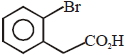
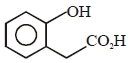
The major aromatic product $C$ in the following reaction sequence will be :
  • A


  • C

  • D

Answer

Correct option: B.

b

Need a full question paper?

Generate a complete, print-ready paper with questions like this in minutes — across 16+ boards, with answer keys.

Start Generating Free

Similar questions

If a skater of weight $3 \,kg$ has initial speed $32\, m/s$ and second one of weight $4 \,kg$ has $5 \,m/s$. After collision, they have speed (couple) $5\, m/s$. Then the loss in K.E. is
The electric field of light wave is given as $\vec E\, = \,{10^{ - 3}}\,\cos \,\,\left( {\frac{{2\pi x}}{{5 \times {{10}^{ - 7}}}} - 2\pi  \times 6 \times {{10}^{14}}t} \right)\hat x\frac{N}{C}$. This light falls on a metal plate of work function $2\,eV.$ The stopping potential of the photoelectrons is ................ $V$
In the magnetic meridian of a certain place, the horizontal component of the earth’s magnetic field is $0.26\;G$ and the dip angle is $60^o$. What is the magnetic field of the earth at this location?
A particle of mass $m$ undergoes oscillations about $x=0$ in a potential given by $V(x)-\frac{1}{2} k x^2-V_0 \cos \left(\frac{x}{a}\right)$, where $V_0, k, a$ are constants. If the amplitude of oscillation is much smaller than $a$, the time period is given by
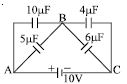
In the circuit shown in figure, four capacitors are connected to a battery. The maximum energy is stored in the capacitor of.....$\mu F$
When a coil is connected across a $20 \mathrm{~V}$ dc supply, it draws a current of $5 \mathrm{~A}$. When it is connected across $20 \mathrm{~V}, 50 \mathrm{~Hz}$ ac supply, it draws a current of $4 \mathrm{~A}$. The self inductance of the coil is .............. $\mathrm{mH}$. (Take $\pi=3$ )
$200 \,g$ of ice at $-20^{\circ} C$ is mixed with $500 \,g$ of water at $20^{\circ} C$ in an insulating vessel. Final mass of water in vessel is ........... $g$ (specific heat of ice $=0.5 \,cal g ^{-10} C ^{-1}$ )
For ideal gas, which statement is not true
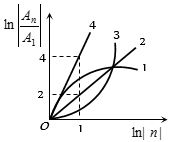
The figure shows a graph between $\ln \left| {\frac{{{A_n}}}{{{A_1}}}} \right|$ and $ln|n|$, where ${A_n}$ is the area enclosed by the nth orbit in a hydrogen like atom. The correct curve is
The half life of radioactive Radon is $3.8$ days. The time at the end of which $1/{20^{th}}$ of the Radon sample will remain undecayed is ........... $day$ (Given ${\log _{10}}e = 0.4343$)