MCQ
The mass of a neutron is the same as that of
  • A proton
  • B
    A meson
  • C
    An epsilon
  • D
    An electron

Answer

Correct option: A.
A proton
a
(a)

Need a full question paper?

Generate a complete, print-ready paper with questions like this in minutes — across 16+ boards, with answer keys.

Start Generating Free

Similar questions

The radius of a soap bubble whose potential is $16\,V$ is doubled. The new potential of the bubble will be.....$V$
A Carnot engine works first between $200^{\circ} C$ and $0^{\circ} C$ and then between $0^{\circ} C$ and $-200^{\circ} C$. The ratio of its efficiency in the two cases is
Light is incident normally on a completely absorbing surface with an energy flux of $25\,W\,cm^{-2}.$ If the surface has an area of $25\,cm^2,$ the maximum momentum transferred to the surface in $40\,min$ time duration will be
Consider an electron $(m = 9.1 \times {10^{ - 31}}kg)$ confined by electrical forces to move between two rigid walls separated by $1.0 \times {10^{ - 9}}$ metre, which is about five atomic diameters. The quantised energy value for the lowest stationary state is
The laptop PC’s modern electronic watches and calculators use the following for display
In an ammeter, $5 \%$ of the main current passes through the galvanometer. If resistance of the galvanometer is $G,$ the resistance of ammeter will be $:$
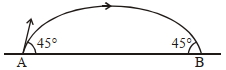
The projectile motion of a particle of mass $5\, g$ is shown in the figure.

The initial velocity of the particle is $5 \sqrt{2}\, ms ^{-1}$ and the air resistance is assumed to be negligible. The magnitude of the change in momentum between the points $A$ and $B$ is $x \times 10^{-2}\, kgms ^{-1} .$ The value of $x ,$ to the nearest integer, is ...... .
Moment of Inertia $(M.I.)$ of four bodies having same mass ' $M$ ' and radius ' $2 R^{\prime}$ are as follows

$I _{1}=$ $M.I.$ of solid sphere about its diameter

$I _{2}=$ $M.I.$ of solid cylinder about its axis

$I _{3}=$ $M.I.$ of solid circular disc about its diameter

$I _{4}=$ $M.I.$ of thin circular ring about its diameter

If $2\left(I_{2}+I_{3}\right)+I_{4}=x$. $I_{1}$ then the value of $x$ will be.......
A conducting sphere of radius $R$, and carrying a charge $q$ is joined to a conducting sphere of radius $2R$, and carrying a charge $-2q$. The charge flowing between them will be
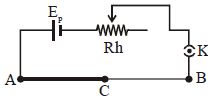
A potentiometer consists of two wires $AC$ and $CB$ of same material and of equal lengths but diameters in the ratio $3 : 1.$ Then the potential gradients on the two wires will be in the ratio :-