MCQ
The mass of a photon electron is:
- A9.1×10−27kg
- B9.1×10−29kg
- C9.1×10−31kg
- D9.1×10−34kg
Explanation:
The mass of a photon electron is 9.1×10⁻³¹ kg.
Generate a complete, print-ready paper with questions like this in minutes — across 16+ boards, with answer keys.
Four capacitors are connected as shown in the figure. Their capacities are indicated in the figure. The effective capacitance between points x and y is (in μF)

|
(a) |
(b) |
(c) |
(d) 2 |
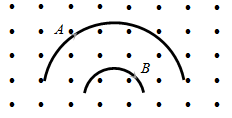
Two particles A and B of masses  and
and  respectively and having the same charge are moving in a plane. A uniform magnetic field exists perpendicular to this plane. The speeds of the particles are
  and
and  respectively, and the trajectories are as shown in the figure. Then
|
(a) |
(b) |
|
(c) |
(d) |
The ionization potential for second He electron is
|
(a) 13.6 eV |
(b) 27.2 eV |
(c) 54.4 eV |
(d) 100 eV |
The electric potential at a point (x, y) in the x - y plane is given by V = -kxy. The field intensity at a distance r from the origin varies as
|
(a) |
(b) r |
(c) |
(d) |
A 40 mF capacitor in a defibrillator is charged to 3000 V. The energy stored in the capacitor is sent through the patient during a pulse of duration 2ms. The power delivered to the patient is
|
(a) 45 kW |
(b) 90 kW |
(c) 180 kW |
(d) 360 kW |
Two identical magnetic dipoles of magnetic moments 1.0 A-m2 each, placed at a separation of 2m with their axis perpendicular to each other. The resultant magnetic field at a point midway between the dipoles is
(a) 5 
|
(b) 
|
(c)
|
(d) None of these |