Question
The mass of a proton is $1.67 \times 10^{-27} \mathrm{~kg}$. How many protons would make 1 g ?
Answer

Number of protons $=\frac{\text{Total mass}}{\text{mass of each proton}}$ $=\frac{10^{-3}}{1.67\times10^{-27}}$ $=5.99\times10^{23}$

Need a full question paper?

Generate a complete, print-ready paper with questions like this in minutes — across 16+ boards, with answer keys.

Start Generating Free

Similar questions

Find the dimensions of:
  1. Linear momentum.
  2. Frequency.
  3. Pressure.
We can shield a charge from electric fields by putting it inside a hollow conductor. Can we shield a body from the gravitational influence of nearby matter by putting it inside a hollow sphere or by some other means?
Find the dimensions of :
  1. Angular speed $\omega.$
  2. Angular acceleration $\alpha.$
  3. Torque $\tau$ and
  4. Moment of interia $I$.
Some of the equations involving these quantities are $\omega=\frac{\theta_2-\theta_1}{\text{t}_2-\text{t}_1},\alpha=\frac{\omega_2-\omega_1}{\text{t}_2-\text{t}_1},\tau=\text{F.r}$ and $\text{I = mr}^2.$
The symbols have standard meanings.
It is desirable that the standards of units be easily available, invariable, indestructible and easily reproducible. If we use foot of a person as a standard unit of length, which of the above features are present and which are not?
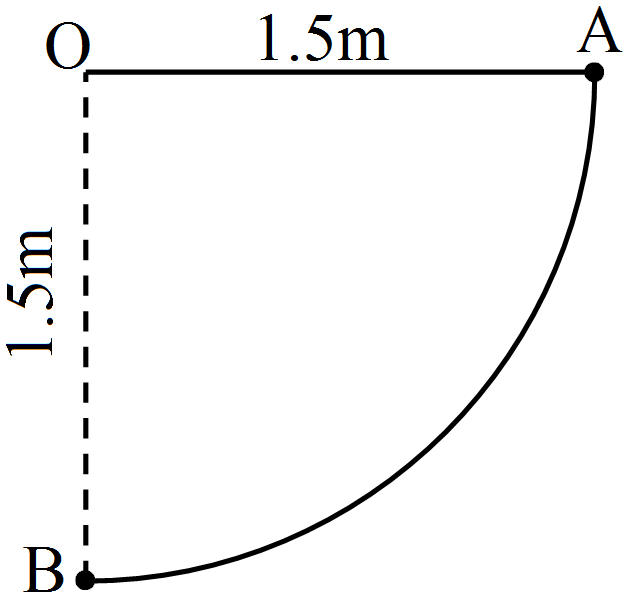
The bob of a pendulum is released from a horizontal A as shown. If the length of the pendulum is $1.5m$, what is the speed with which the bob arrives at the lowermost point B, given that it dissipates 5% of its initial energy against air resistance?
Out of the four fundamental forces which one is:
  1. Strongest.
  2. Weakest?
A vertical rod is hit at one end. What kind of wave propagates in the rod if:
  1. The hit is made vertically.
  2. The hit is made horizontally?
Calculate the energy required to move an earth satellite of mass $10^3 kg$ from a circular orbit of radius 2 R to that of radius 3R. Given mass of the earth, $M=5.98 \times 10^{24} kg$ and radius of the earth, $R=6.37 \times 10^6 m$.
A barometer is constructed with its tube having radius 1.0 mm . Assume that the surface of mercury in the tube is spherical in shape. If the atmospheric pressure is equal to 76 cm of mercury, what will be the height raised in the barometer tube. The contact angle of mercury with glass $=135^{\circ}$ and surface tension of mercury $=0.465 \mathrm{~N} / \mathrm{m}$. Density of mercury $=13600 \mathrm{~kg} / \mathrm{m}^3$.