MCQ
The mass of a spaceship in $1000\,kg$. It is to be launched from the earth's surface out into free space. The value of $'g'$ and $'R'$ (radius of earth) are $10\, m/s^2$ and $6400\, km$ respectively. The required energy of this work will be
  • A
    $6.4\times10^{11}$ Joules
  • B
    $6.4\times10^{8}$ Joules
  • C
    $6.4\times10^{9}$ Joules
  • $6.4\times10^{10}$ Joules

Answer

Correct option: D.
$6.4\times10^{10}$ Joules
d
$\mathrm{W}=0-\left(-\frac{\mathrm{GMm}}{\mathrm{R}}\right)=\frac{\mathrm{GMm}}{\mathrm{R}}$

$=g R^{2} \times \frac{m}{R}=m g R$

$=1000 \times 10 \times 6400 \times 10^{3}$

$=64 \times 10^{9} \mathrm{J}$

$=6.4 \times 10^{10} \mathrm{J}$

Need a full question paper?

Generate a complete, print-ready paper with questions like this in minutes — across 16+ boards, with answer keys.

Start Generating Free

Similar questions

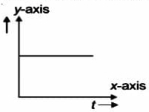
In the graph shown in figure, which quantity associated with projectile motion is plotted along $y$-axis?
Electromagnetic waves are produced by:
A cubical box with porous walls containing an equal number of ${O_2}$ and $H_2$ molecules is placed in a large evacuated chamber. The entire system is maintained at constant temperature $T.$ The ratio of ${v_{rms}}$ of ${O_2}$ molecules to that of the ${v_{rms}}$ of $H_2$ molecules, found in the chamber outside the box after a short interval is
Certain neutron stars are believed to be rotating at about $1\,rev/\sec $. If such a star has a radius of $ 20\, km$, the acceleration of an object on the equator of the star will be
Given below are two statements:

Statement $I:$ If heat is added to a system, its temperature must increase.

Statement $II:$ If positive work is done by a system in a thermodynamic process, its volume must increase.

In the light of the above statements, choose the correct answer from the options given below

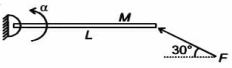
The thin rod shown below has mass $M$ and length $L$. A force $F$ acts at one end as shown and the rod is free to rotate about the other end in the plane of force. Initial angular acceleration of the rod is ........
A cricketer can throw a ball to a maximum horizontal distance of $100 \,m$. With the same effort, he throws the ball vertically upwards. The maximum height attained by the ball is  ......... $m$
Newton's third law of motion leads to the law of conservation of
If the length of a closed organ pipe is 1 m and velocity of sound is $330 m / s$, then the frequency for the second note is
The energy of an atom $($or ion$)$ in its ground state is $-54.4eV$. It may be: