MCQ
The maximum area of a right angled triangle with hypotenuse $h$ is
  • A
    $\frac{{{h^2}}}{{2\sqrt 2 }}$
  • B
    $\frac{{{h^2}}}{{2}}$
  • C
    $\frac{{{h^2}}}{{\sqrt 2 }}$
  • $\frac{{{h^2}}}{{4}}$

Answer

Correct option: D.
$\frac{{{h^2}}}{{4}}$
d
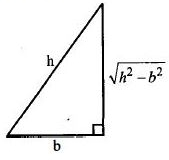
Let base $=b$

Altitude (or perpendicur) $ = \sqrt {{h^2} - {b^2}} $

Area, $\mathrm{A}=\frac{1}{2} \times$ base $\times$ altitude

$=\frac{1}{2} \times b \times \sqrt{h^{2}-b^{2}}$

$\Rightarrow \frac{d \mathrm{A}}{d b}=\frac{1}{2}\left[\sqrt{h^{2}-b^{2}}+b \cdot \frac{-2 b}{2 \sqrt{h^{2}-b^{2}}}\right]$

$=\frac{1}{2}\left[\frac{h^{2}-2 b^{2}}{\sqrt{h^{2}-b^{2}}}\right]$

Put $\frac{d \mathrm{A}}{d b}=0,$

$\Rightarrow \quad b=\frac{h}{\sqrt{2}}$

Maximum area $=\frac{1}{2} \times \frac{h}{\sqrt{2}} \times \sqrt{h^{2}-\frac{h^{2}}{2}}=\frac{h^{2}}{4}$
Need a full question paper?

Generate a complete, print-ready paper with questions like this in minutes — across 16+ boards, with answer keys.

Start Generating Free

Similar questions

Let $e^{f(x)} = ln x .$ If $g(x)$ is the inverse function of $f(x)$ then $g ‘ (x)$ equals to :
The maximum and minimum values of ${x^3} - 18{x^2} + 96x$ in interval  $(0, 9)$  are
The value of $\sin^{-1}\Big(\cos\frac{33\pi}{5}\Big)$ is:
On the interval $\left[ {\frac{{5\pi }}{3},\,\,\frac{{7\pi }}{4}} \right],$ the greatest value of the function $f(x) = \int_{5\pi /3}^x {(6\cos t - 2\sin t)\,dt = } $
A tangent having slope of $-\frac{4}{3}$ to the ellipse $\frac{\text{x}^2}{18}+\frac{\text{y}^2}{32}=1$ ntersects the major and minor axes at points $A$ and $B$ respectively. If $C$ is the center of the ellipse, then area of the triangle $\text{ABC}$ is:
Let $y=y(x)$ be solution of the differential equation $\log _{e}\left(\frac{d y}{d x}\right)=3 x+4 y$, with $y(0)=0$. If $y\left(-\frac{2}{3} \log _{e} 2\right)=\alpha \log _{e} 2$, then the value of $\alpha$ is equal to:
The real valued function $f(x)=\frac{\operatorname{cosec}^{-1} x}{\sqrt{x-[x]}, \text { where }}$ $[ x ]$ denotes the greatest integer less than or equal to $x,$ is defined for all $x$ belonging to
Let $A = \left[ {\begin{array}{*{20}{c}}
1&2&3\\
2&2&{ - 1}\\
3&0&k
\end{array}} \right]$ and $f(x) = {x^3} - 2{x^2} - \alpha x + \beta  = 0$ . If $A$ satisfies $f(x)=0$ ,then
If $\vec{\text{a}},\ \vec{\text{b}}$ are the vectors forming consecutive sides of a regular hexagon ABCDEF, then the vector representing side CD is,
The equation of the curve passing through the origin and satisfying the differential equation $\left( {1 + {x^2}} \right)\,\frac{{dy}}{{dx}} + 2xy = 4{x^2}$ is