MCQ
The maximum current that flows through a fuse wire before it blows out varies with its radius as
  • $r^{3 / 2}$
  • B
    r
  • C
    $r^{2 / 3}$
  • D
    $r^{1 / 2}$

Answer

Correct option: A.
$r^{3 / 2}$
(a) $r^{3 / 2}$

Need a full question paper?

Generate a complete, print-ready paper with questions like this in minutes — across 16+ boards, with answer keys.
Start Generating Free

Similar questions

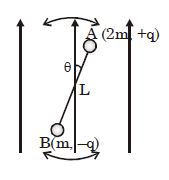
As shown in the figure, a particle A of mass $2\,m$ and carrying charge $q$ is connected by a light rigid rod of length $L$ to another particle $B$ of mass $m$ and carrying charge $-q.$ The system is placed in an electric field $\vec E$ . The electric force on a charge $q$ in an electric field $\vec E$ is $\vec F = q \vec E $ . After the system settles into equilibrium, one particle is given a small push in the transverse direction so that the rod makes a small angle $\theta_0$ with the electric field. Find maximum tension in the rod.
The rest energy of an electron is 0.511 MeV. The electron is accelerated from rest to a velocity 0.5 c. The change in its energy will be
The fine powder of a coloured glass is seen as
The condition for a uniform spherical mass m of radius r to be a black hole is [G = gravitational constant and g = acceleration due to gravity]
By corpuscular theory of light, the phenomenon which can be explained is
Heat produced in a wire of resistance $R$ due to current flowing at constant potential difference is proportional to
$10^{-3}$ amp is flowing through a resistance of 1000Ω. To measure the correct potential difference, the voltmeter is to be used of which the resistance should be
If the temperature of cold junction of a thermocouple is lowered, then the neutral temperature:
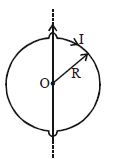
A circular conducting loop of radius $R$ carries a current $I.$ Another straight infinite conductor carrying current $I$ passes through the diameter of this loop as shown in the figure. The magnitude of force exerted by the straight conductor on the loop is
If frequency of electromagnetic wave is $60 \mathrm{MHz}$ and it travels in air along $\mathrm{z}$ direction then the corresponding electric and magnetic field vectors will be mutually perpendicular to each other and the wavelength of the wave (in $\mathrm{m}$ ) is :