MCQ
The maximum energy is possessed by an electrons, when it is present
  • A
    in nucleus
  • B
    in ground energy state
  • C
    in first excited state
  • at infinite distance from the nucleus

Answer

Correct option: D.
at infinite distance from the nucleus
d
As we know that $E_n\, \propto\,\left[-\frac{1}{n^2}\right]$ where $n$ is the number of orbit. Hence, as the value of $n$ increases, energy of the electron also increases. Hence, when $n$ becomes infinite, energy also becomes infinite. Hence, due to this reason maximum energy is possessed by an electron, when it is present at infinite distance from the nucleus.

Need a full question paper?

Generate a complete, print-ready paper with questions like this in minutes — across 16+ boards, with answer keys.
Start Generating Free

Similar questions

For the reaction at $25\,^oC$ ${N_2}{O_{4(g)}}\,\, \rightleftharpoons \,\,2N{O_{2(g)}},$ if $\Delta {G^o}_f$ for $N_2O_4$ and $NO_2$ are $23.49$ and $12.39\,kcal$, then $K_p$ for the reaction is
(image) $\xrightarrow[CC{{l}_{4}}]{HCl}X\xrightarrow{Aq.NaOH}Y\xrightarrow[\Delta ]{Conc.{{H}_{3}}P{{O}_{4}}}Z$ Major product is
If the $IP$ of $Na$ is $5.48 \,eV$, the ionisation potential of $K$ will be ............ $\mathrm{eV}$
The electrophile, ${E^ \oplus }$ attacks the benzene ring to generate the intermediate $\sigma -$complex. Of the following, which $\sigma -$ complex is lowest energy ?
$RN{H_2}$ reacts with ${C_6}{H_5}S{O_2}Cl$ in aqueous $KOH$ to give a clear solution. On acidification a precipitate is obtained which is due to the formation of
Which one of the following compounds will be most reactive for $S_N1$ reactions :
$\begin{array}{*{20}{c}}
  {\begin{array}{*{20}{c}}
  {C{H_3\,\,}} \\ 
  {\,|\,\,\,\,\,\,\,\,\,\,} 
\end{array}\,\,\,\,\,\,\,\,\,} \\ 
  {C{H_3} - C - CH = C{H_2}\,\,} \\ 
  {\,|\,\,\,\,\,\,\,\,\,\,\,\,\,\,\,\,\,\,\,\,} \\ 
  {\,\,C{H_3}\,\,\,\,\,\,\,\,\,\,\,\,\,\,} 
\end{array}\xrightarrow[{{H_2}{O_2}|\mathop {OH}\limits^\Theta  }]{{{B_2}{H_6}|THF}}\,(Z)$ Major product
The position of some metals in the electrochemical series in decreasing electropositive character is given as $Mg > Al > Zn > Cu > Ag.$ What will happen, if a copper spoon is used to stir a solution of aluminium nitrate
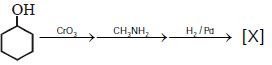
Product $[X]$ of given reaction is
One of the functional group present in the product of reaction between phenol and chloroform in alkaline medium is