MCQ
The maximum energy is present in any electron at
  • A
    Nucleus
  • B
    Ground state
  • C
    First excited state
  • Infinite distance from the nucleus

Answer

Correct option: D.
Infinite distance from the nucleus
d
(d) As a result of attraction, some energy is released. So at infinite distance from the nucleus energy of any electron will be maximum. For bringing electrons from $\infty $ to the orbital of any atom some work has to be done be electrons hence it bill loose its energy for doing that work.

Need a full question paper?

Generate a complete, print-ready paper with questions like this in minutes — across 16+ boards, with answer keys.
Start Generating Free

Similar questions

A zero order reaction is one whose rate is independent of
$CH_3 -C \equiv C-CH$ $\xrightarrow[{(2)\,{H_2}O}]{{(1)\,\,{O_3}}}X\xrightarrow[\Delta ]{{\left( {NaOH + CaO} \right)}}Y$; $Y$ is
The solubility product constant ${K_{sp}} $ of $Mg{(OH)_2}$ is $9.0 \times {10^{ - 12}}.$ If a solution is $0.010\,\,M$ with respect to $M{g^{2 + }}$ ion, what is the maximum hydroxide ion concentration which could be present without causing the precipitation of $Mg\,{(OH)_2}$
The correct order of decreasing ionic nature of lead dihalides is
Which of the following has longest $C-O$ bond length ? (Free $C-O$ bond length in $CO$ is $1.128\,\mathop A\limits^o .$)
The ground state energy of hydrogen atom is $-13.6\, eV$. The energy of second excited state of $He^+$ ion in $eV$ is
In trimer form of sulphur trioxide, each sulphur atom is bonded with
An organic compound on analysis gave $C = 48\, gm$, $H = 8 \,gm$ and $N = 56\, gm$. Volume of $1.0\, g$ of the compound was found to be $200 \,ml$ at $NTP$. Molecular formula of the compound is
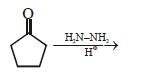
 The above reaction completes with the mechanism
Compare $\pi  - $ bond strength between $B$ and $N$ given in two compounds

$(I)$ $\begin{array}{*{20}{c}}
{{{\left( {C{H_3}} \right)}_3}Si - NB{H_2}}\\
{\,\,\,\,\,\,\,\,\,\,\,\,\,\,\,\,|}\\
{\,\,\,\,\,\,\,\,\,\,\,\,\,\,\,\,\,\,\,\,\,\,\,\,\,\,\,\,\,\,\,Si{{(C{H_3})}_3}}
\end{array}$     $(II)$ $\begin{array}{*{20}{c}}
{{{\left( {C{H_3}} \right)}_3}C - NB{H_2}}\\
{\,\,\,\,\,\,\,\,\,\,\,\,\,\,\,\,|}\\
{\,\,\,\,\,\,\,\,\,\,\,\,\,\,\,\,\,\,\,\,\,\,\,\,\,\,\,\,\,\,\,C{{(C{H_3})}_3}}
\end{array}$