MCQ
The maximum horizontal range of a projectile is $16\,km$ when the projectile is thrown at an elevation of $30^o$ from the horizontal, it will reach to the maximum height of ....... $km$
  • $2$
  • B
    $4$
  • C
    $8$
  • D
    $16$

Answer

Correct option: A.
$2$
a
$\mathrm{R}=\frac{\mathrm{u}^{2} \sin 2 \theta}{\mathrm{g}}$ so that $\mathrm{R}_{\max }=\frac{\mathrm{u}^{2}}{\mathrm{g}}=16 \mathrm{km}$

$\mathrm{H}_{\max }=\frac{\mathrm{u}^{2} \sin ^{2} \theta}{2 \mathrm{g}}=2 \mathrm{km}$

Need a full question paper?

Generate a complete, print-ready paper with questions like this in minutes — across 16+ boards, with answer keys.
Start Generating Free

Similar questions

A sinusoidal voltage of peak value $283\,V$ and frequency $50\,Hz$ is applied to a series $LCR$ circuit in which $R =3 \;\Omega, L =25.48\; mH$, and $C =79 \,\mu F$. Find the impedance of the circuit $............\Omega$
The hottest planet of solar system is
If $a$ person sitting on $a$ rotating stool with his hands outstretched, suddenly lowers his hands, then his
No bias is applied to a $P-N$ junction, then the current
A beam of parallel rays is brought to a focus by a plano-convex lens. A thin concave lens of the same focal length is joined to the first lens. The effect of this is
In a reactor, $2\, kg$ of ${ }_{92} U ^{235}$ fuel is fully used up in $30$ days. The energy released per fission is $200\, MeV.$ Given that the Avogadro number, $N =6.023 \times 10^{26}$ per kilo mole and $1\, eV =1.6 \times 10^{-19}\, J .$ The power output of the eactor is close to$.....MW$
Water is flowing in a pipe of diameter $ 4 cm$  with a velocity $3 m/s. $ The water then enters into a tube of diameter $ 2 cm.$  The velocity of water in the other pipe is .......... $m/s$
Inertia is that property of a body by virtue of which the body is
What will be the acceleration due to gravity at height $h$ if $h >> R$. Where $R$ is radius of earth and $g$ is acceleration due to gravity on the surface of earth
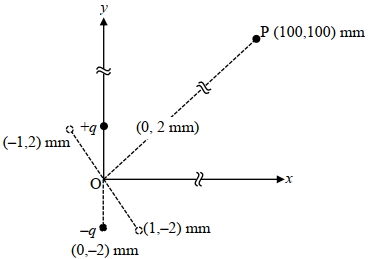
An electric dipole is formed by two charges $+q$ and $-q$ located in xy-plane at $(0,2) \mathrm{mm}$ and $(0,-2) \mathrm{mm}$, respectively, as shown in the figure. The electric potential at point $\mathrm{P}(100,100) \mathrm{mm}$ due to the dipole is $V_0$. The charges $+q$ and $-q$ are then moved to the points $(-1,2) \mathrm{mm}$ and $(1,-2) \mathrm{mm}$, respectively. What is the value of electric potential at $P$ due to the new dipole?