Question
The maximum percentage errors in the measurement of mass (M), radius (R) and angular velocity $(\omega)$ of a ring are $2 \%, 1 \%$ and $1 \%$ respectively, then find the maximum percenta? error in the measurement of its moment of inertia $\left(I=\frac{1}{2} M R^{2}\right)$ about its geometric axis.
Answer

Moment of inertia ${\rm{(I)  =  M}}{{\rm{R}}^{\rm{2}}}{\rm{ }}$

$\therefore \,\,\frac{{\Delta I}}{I}\,\, \times \,\,100\,\, = \,\,\frac{{\Delta M}}{M}\,\, \times \,\,100\,\, + \;\;2\frac{{\Delta R}}{R}\,\, \times \,\,100$

$\, = \,\,2\% \,\, + \;\,\left( {2\,\, \times \,\,1\% } \right)\,\, = \,\,4\% $

the maximum percenta  $\, = \,\,4\% $

Need a full question paper?

Generate a complete, print-ready paper with questions like this in minutes — across 16+ boards, with answer keys.

Start Generating Free

Similar questions

A crew of scientists has built a new space station. The space station is shaped like a wheel of radius $R,$ with essentially all its mass $M$ at the rim. When the crew arrives, the station will be set rotating at a rate that causes an object at the rim to have radial acceleration $g,$ thereby simulating Earth's surface gravity. This is accomplished by two small rockets, each with thrust $T$ newtons, mounted on the station's rim. How long a time $t$ does one need to fire the rockets to achieve the desired condition?
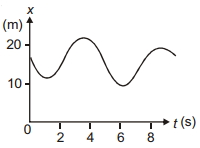
Figure shows the position of a particle moving on the $x$-axis as a function of time
A pendulume clock loses $12\;s$ a day if the temperature is $40^oC$ and gains $4\;s$ a day if the temperature is $20^oC$. The temperature at which the clock will show correct time, and the coeffecient of linear expansion $(\alpha)$ of the metal of the pendulum shaft are respectively
$4$ moles of an ideal gas is at $0°C.$ At constant pressure it is heated to double its volume, then its final temperature will be ...... $^oC$
Imagine that a reactor converts all given mass into energy and that it operates at a power level of $10^9\, watt$. The mass of the fuel consumed per hour in the reactor will be : (velocity of light, $c$ is $3\times10^8\, m/s$)
Sound waves of wavelength greater than that of audible sound are called
The weight of a body on the surface of the earth is $100\,N$. The gravitational force on it when taken at a height, from the surface of earth, equal to onefourth the radius of the earth is $..........\,N$
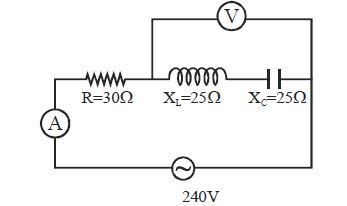
In the circuit shown in figure neglecting source resistance the voltmeter and ammeter reading will respectively be
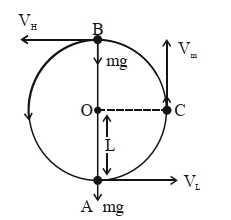
A bob of mass ' $m$ ' is suspended by a light string of length ' $L$ '. It is imparted a minimum horizontal velocity at the lowest point $A$ such that it just completes half circle reaching the top most position B. The ratio of kinetic energies $\frac{(\text { K.E. })_A}{(\text { K.E. })_B}$ is:
In a triode amplifier, $\mu = 25,\,{r_p} = 40$ kilo ohm and load resistance ${R_L} = 10$ kilo ohm. If the input signal voltage is $0.5 volt$, then output signal voltage will be.....$volt$