MCQ
The maximum value of $\Big(\frac{1}{\text{x}}\Big)^\text{x}$ is:
  • A
    $\text{e}$
  • B
    $\text{e}^\text{e}$
  • C
    $\frac{1}{_\text{e}\text{e}}$
  • D
    $\Big(\frac{1}{\text{e}}\Big)^{\frac{1}{\text{e}}}$

Answer

  1. $\text{e}^{\frac{1}{\text{e}}}$

Solution:

Let $\text{y}=\Big(\frac{1}{\text{x}}\Big)^\text{x}$

$\Rightarrow\ \log\text{y}=\text{x}\cdot\log\frac{1}{\text{x}}=-\text{x}\cdot\log\text{x}$

Diffrentiating both sides w.r.t x, we get,

$\frac{1}{\text{y}}\cdot\frac{\text{dy}}{\text{dx}}=-\text{x}\cdot\frac{1}{\text{x}}-\log\text{x}$

$=-1-\log\text{x}$

$\therefore\ \frac{\text{dy}}{\text{dx}}=-\Big(\frac{1}{\text{x}}\Big)^\text{x}(1+\log\text{x})$

Now, $\frac{\text{dy}}{\text{dx}}=0$

$\Rightarrow\ 1+\log\text{x}=0$

$\Rightarrow\ \text{x}=\frac{1}{\text{e}}$

Sign scheme of f'(x) is as shown in the following figure.
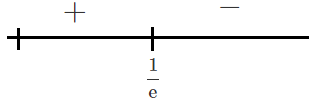
From the figure, $\text{x}=\frac{1}{\text{e}}$ is the point of maxima

Hence, maximum value of y is $\Big(\frac{1}{\frac{1}{\text{e}}}\Big)^{\frac{1}{\text{e}}}=\text{e}^{\frac{1}{\text{e}}}$

Need a full question paper?

Generate a complete, print-ready paper with questions like this in minutes — across 16+ boards, with answer keys.

Start Generating Free

Similar questions

If $A=\left[a_{i j}\right]=\left[\begin{array}{cc}2 & -1 \\ -3 & 4 \\ 1 & 2\end{array}\right]$ and $B=\left[b_{i j}\right]=\left[\begin{array}{ccc}2 & 3 & -5 \\ 1 & 4 & 9 \\ 0 & 7 & -2\end{array}\right]$, then value of $a_{11} b_{11}+a_{22} b_{22}$ is
If $\text{f}(\text{x})=\frac{\sin^{-1}\text{x}}{\sqrt{1-\text{x}}^2},$ then $(1-\text{x})^2\text{f}''(\text{x})-\text{xf}(\text{x})=$
  1. 1
  2. -1
  3. 0
  4. None of these
A solution curve of the differential equation $\left(x^2+x y+4 x+2 y+4\right) \frac{c^{\prime} y}{c^{\prime} x}-y^2=0, x>0$, passes through the point $(1,3)$. Then the solution curve

($A$) intersects $y=x+2$ exactly at one point

($B$) intersects $y=x+2$ exactly at two points

($C$) intersects $y=(x+2)^2$

($D$) does $NOT$ intersect $y=(x+3)^2$

$f(x)$ and $g(x)$ are two differentiable function on $[0,\,2]$ such that , $f''(x) - g''(x) = 0,f'(1) = 2,g'(1) = 4$ ,$f(2) = 3$, $g(2) = 9,$ then $f(x) - g(x)$ at $x = 3/2$ is
The area of the region $\{(\text{x},\text{y}):\text{y}^2\leq4\text{x},4\text{x}^2+4\text{y}^2\leq9\}$ is:
  1. $\frac{\sqrt2}{6}+\frac{9\pi}{8}-\frac{9}{4}\sin-1(\frac{1}{5})$
  2. $\frac{\sqrt2}{6}-\frac{9\pi}{8}$
  3. $\frac{9\pi}{8}-\frac{9}{4}\sin-1(\frac{1}{3})$
  4. $\text{None of these}$
A stone moving vertically upwards has its equation of motion $s = 490t - 4.9{t^2}$. The maximum height reached by the stone is
The curve satisfying the differential equation, $(x^2 -y^2) \,dx + 2xydy\, = 0$ and passing through the point $(1 , 1 )$ is
$\int_{}^{} {\frac{{dx}}{{\cos (x - a)\cos (x - b)}} = } $
Let $f:[0,4 \pi] \rightarrow[0, \pi]$ be defined by $f(x)=\cos ^{-1}(\cos x)$. The number of points $x \in[0,4 \pi]$ satisfying the equation $f(x)=\frac{10-x}{10}$ is
Let $\vec{a}$ and $\vec{b}$ be the vectors along the diagonal of a parallelogram having area $2 \sqrt{2}$. Let the angle between $\vec{a}$ and $\vec{b}$ be acute. $|\vec{a}|=1$ and $|\vec{a} . \vec{b}|=|\vec{a} \times \vec{b}| .$ If $\vec{c}=2 \sqrt{2}(\vec{a} \times \vec{b})-2 \vec{b}$, then an angle between $\vec{b}$ and $\vec{c}$ is