Question
The maximum value of electric field vector $\overrightarrow{ E }$ in a electromagnetic wave is 0.3 mV metre$^{-1}$. Calculate the maximum value of magnetic field vector $\overrightarrow{ B }$.

Answer

Here $E_{0}=0.3\times10^{-3}V~m^{-1}$
∴ $\frac{E_{0}}{B_{0}}=c\Rightarrow B_{0}=\frac{E_{0}}{c}=\frac{0.3\times10^{-3}Vm^{-1}}{3\times10^{8}ms^{-1}}$
$=1.0\times10^{-12}$ Tesla

Need a full question paper?

Generate a complete, print-ready paper with questions like this in minutes — across 16+ boards, with answer keys.
Start Generating Free

Similar questions

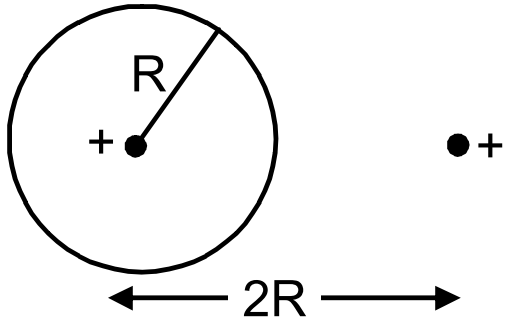
Find the flux of the electric field through a spherical surface of radius $R$ due to a charge of $10^{-7}C$ at the centre and another equal charge at a point $2R$ away from the centre.
Derive the equation of electric potential due to a system of electric charges.
Explain the formation of potential barrier and depletion region in a p-n junction diode. What is effect of applying forward bias on the width of depletion region?
An alternating voltage of frequency $f$ is applied across a series $\text{LCR}$ circuit. Let $f_r$ be the resonance frequency for the circuit. Will the current in the circuit lag, lead or remain in phase with the applied voltage when $(i)\ f > f_r, (ii)\ f < f_r$? Explain your answer in each case.
On which two factors the extent of polarization in a polar dielectric depends ? what is polarization of dielectric ? Write its formula.
A slab of material of dielectric constant $K$ has the same area as the plates of a parallel-plate capacitor but has a thickness $(3 / 4) d$, where $d$ is the separation of the plates. How is the capacitance changed when the slab is inserted between the plates?
Show that the dimensions of the displacement current $\epsilon_0\frac{\text{d}\phi_\text{E}}{\text{dt}}$ are that of an electric current.
A neutron having kinetic energy 12.5eV collides with a hydrogen atom at rest. Nelgect the difference in mass between the neutron and the hydrogen atom and assume that the neutron does not leave its line of motion. Find the possible kinetic energies of the neutron after the event.
Define Volume density of charge. Write its S.I. unit.
Calculate the orbital period of the electron in the first excited state of hydrogen atom.