MCQ
The maximum value of ${\left( {\frac{1}{x}} \right)^{2{x^2}}}$ is
  • A
    $e$
  • $\sqrt[e]{e}$
  • C
    $1$
  • D
    None of these

Answer

Correct option: B.
$\sqrt[e]{e}$
b
Let $y=\left(\frac{1}{x}\right)^{2 x^{2}}$

$\Rightarrow \log y=-2 x^{2} \log x$

$\Rightarrow \frac{1}{y} \frac{d y}{d x}=-4 x \log x-2 x$

$\Rightarrow \frac{d y}{d x}=-2 x(2 \log x+1) y$

$\Rightarrow \frac{d y}{d x}=-2 x\left(\log x^{2}+1\right)\left(\frac{1}{x}\right)^{2 x^{2}}$

Now, the value of $y$ is maximum or minimum when, $\frac{d y}{d x}=0$ $-2 x\left(\log x^{2}+1\right)\left(\frac{1}{x}\right)^{2 x^{2}}=0$

$\Rightarrow \frac{4 x \log x+2 x}{x^{2 x^{2}}}=0$

$\Rightarrow 2 x=-4 x \log x$

$\Rightarrow \log x=\frac{-1}{2}$

$\Rightarrow x=\frac{1}{\sqrt{e}}$

Its double derivative will be negative there hence value will be maximum

Thus, the maximum value of $y$ is,

$\Rightarrow\left(\frac{1}{\frac{1}{\sqrt{e}}}\right)^{2\left(\frac{1}{\sqrt{e}}\right)^{2}}$

$\Rightarrow(\sqrt{e})^{\frac{2}{e}}$

$\Rightarrow e^{\frac{1}{2} \times \frac{2}{e}}$

$\Rightarrow e^{\frac{1}{e}}$

Need a full question paper?

Generate a complete, print-ready paper with questions like this in minutes — across 16+ boards, with answer keys.
Start Generating Free

Similar questions

The first term of an $A.P.$ of consecutive integers is ${p^2} + 1$ The sum of $(2p + 1)$ terms of this series can be expressed as
Let $A$ be a matrix of order $2 \times 2$, whose entries are from the set $\{0,1,2,3,4,5\}$. If the sum of all the entries of $A$ is a prime number $p , 2< p <8$, then the number of such matrices $A$ is
All the vertices of a rectangle are of the form $(a, b)$ with $a, b$ integers satisfying the equation $(a-8)^2-(b-7)^2=5$. Then, the perimeter of the rectangle is
Let $\mathrm{x}_1, \mathrm{x}_2, \mathrm{x}_3, \mathrm{x}_4$ be the solution of the equation $4 x^4+8 x^3-17 x^2-12 x+9=0$ and $\left(4+x_1^2\right)\left(4+x_2^2\right)\left(4+x_3^2\right)\left(4+x_4^2\right)=\frac{125}{16} m$. Then the value of $\mathrm{m}$ is..........
If $x$ be real, then the maximum value of $5 + 4x - 4{x^2}$ will be equal to
Let $P({x_1},{y_1})$ and $Q({x_2},{y_2})$ are two points such that their abscissa ${x_1}$ and ${x_2}$ are the roots of the equation ${x^2} + 2x - 3 = 0$ while the ordinates ${y_1}$ and ${y_2}$ are the roots of the equation ${y^2} + 4y - 12 = 0$. The centre of the circle with $PQ$ as diameter is
Let $g(x)=\int_0^{|x|^{3 / 4}} t^{2 / 3} \sin \frac{1}{t} d t$, for all real $x$. Then, $\lim _{x \rightarrow 0} \frac{g(x)}{x}$ is equal to
Three coins are tossed. If one of them shows tail, then the probability that all three coins show tail, is
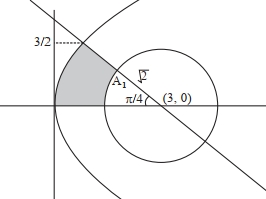
If the area bounded by the curve $2 y^2=3 x$, lines $x+y=3, y=0$ and outside the circle $(x-3)^2+y^2=2$ is $A$, then $4(\pi+4 A )$ is equal to $.........$.
A helicopter is flying along the curve given by $y - x^{3/2} = 7, (x  \geq  0)$. A solider positioned at the point $\left( {\frac{1}{2},7} \right)$ wants to shoot down the helicopter when it is nearest to him. Then this nearest distance is