MCQ
The maximum value of ${x^4}{e^{ - {x^2}}}$ is
  • A
    $e^2$
  • B
    $e^{-2}$
  • C
    $12e^{-2}$
  • $4e^{-2}$

Answer

Correct option: D.
$4e^{-2}$
d
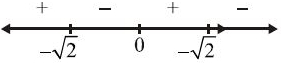
$f(x)=x^{4} e^{-x^{2}}$ or $f^{\prime}(x)=4 x^{3} e^{-x^{2}}+x^{4} e^{-x^{2}}(-2 x)$

$2 x^{3} e^{-x^{2}}\left(2-x^{2}\right)$

Sign scheme of $f^{\prime}(x)$ is as follows:

Hence, $f(x)$ is maximum at $x=\pm \sqrt{2}.$

Thus, maximum value $=4 \mathrm{e}^{-2}.$
Need a full question paper?

Generate a complete, print-ready paper with questions like this in minutes — across 16+ boards, with answer keys.

Start Generating Free

Similar questions

The solution of the differential equation $y - x\frac{{dy}}{{dx}} = a\left( {{y^2} + \frac{{dy}}{{dx}}} \right)$ is
A possible value of $^{\prime}x^{\prime}$, for which the ninth term in the expansion of $\left\{3^{\log _{3} \sqrt{25^{x-1}+7}}+3^{\left(-\frac{1}{8}\right) \log _{3}\left(5^{x-1}+1\right)}\right\}^{10}$ in the increasing powers of $3^{\left(-\frac{1}{8}\right) \log _{3}\left(5^{x-1}+1\right)}$ is equal to $180$ , is:
If seven women and seven men are to be seated around a circular table such that there is a man on either side of every woman, then the number of seating arrangements is
Let $\vec{a}=\hat{i}+\hat{j}+\hat{k}, \vec{b}=\hat{i}-\hat{j}+\hat{k}$ and $\vec{c}=\hat{i}-\hat{j}-\hat{k}$ be three vectors. A vector $\vec{v}$ in the plane of $\vec{a}$ and $\vec{b}$, whose projection on $\vec{c}$ is $\frac{1}{\sqrt{3}}$, is given by
Number of complex numbers $z$ such that $\left| z \right| + z - 3\bar z = 0$ is equal to
Consider the parabola $y^2=8 x$. Let $\Delta_1$ be the area of the triangle formed by the end points of its latus rectum and the point $P\left(\frac{1}{2}, 2\right)$ on the parabola, and $\Delta_2$ be the area of the triangle formed by drawing tangents at $P$ and at the end points of the latus rectum. Then $\frac{\Delta_1}{\Delta_2}$ is
Let $f$ be a real valued function defined by

$f(x) = sin^{-1} \left( {\frac{{\,\,1 - \,\,\left| x \right|}}{3}} \right) + cos^{-1}\left( {\frac{{\left| x \right|\,\, - \,\,3}}{5}} \right)$ .

Then domain of $f(x)$ is given by :

Let $E$ denote the set of letters of the English alphabet, $V=\{a, e, i, o, u\}$ and $C$ be the complement of $V$ in $E$. Then, the number of four-letter words (where repetitions of letters are allowed) having at least one letter from $V$ and at least one letter from $C$ is
$\mathop {\lim }\limits_{x \to 0} \frac{{{4^x} - {9^x}}}{{x({4^x} + {9^x})}} = $
If the system of linear equation $x + 2ay + az = 0,$ $x + 3by + bz = 0,$ $x + 4cy + cz = 0$  has a non zero solution, then $a,b,c$