MCQ
The maximum wavelength of radiation emitted at $2000\;K$is $4\mu m$. What will be the maximum wavelength of radiation emitted at $2400\,K$ is ...... $\mu m$
  • $3.33$
  • B
    $0.66$
  • C
    $1$
  • D
    $0.1$

Answer

Correct option: A.
$3.33$
a
(a) $\therefore $$\frac{{{\lambda _{{m_2}}}}}{{{\lambda _{{m_1}}}}} = \frac{{{T_1}}}{{{T_2}}}$$ \Rightarrow {\lambda _{{m_2}}} = \frac{{2000}}{{2400}} \times 4 = 3.33\;\mu m$

Need a full question paper?

Generate a complete, print-ready paper with questions like this in minutes — across 16+ boards, with answer keys.
Start Generating Free

Similar questions

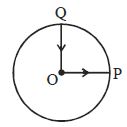
A cyclist starts from the centre $O$ of a circular park of radius one kilometre, reaches the edge $P$ of the partk. Then cycles along the circumference and returns to the centre along $QO$ as shown in the figure. If the round trip takes ten minutes, the net displacement and average speed of the cyclist (in metre and kilometre per hour respectively) is
$A$ and $B$ are two wires. The radius of $A$ is twice that of $B.$ They are stretched by the some load. Then the stress on $B$ is
In an adiabatic change, the pressure $P$ and temperature $T$ of a monoatomic gas are related by the relation $P \propto {T^C}$, where $C$ equals
Which of the following parameters is the same for molecules of all gases at a given temperature?
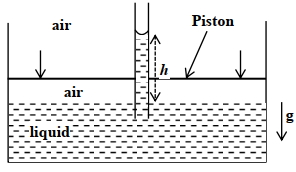
An incompressible liquid is kept in a container having a weightless piston with a hole. A capillary tube of inner radius $0.1 \mathrm{~mm}$ is dipped vertically into the liquid through the airtight piston hole, as shown in the figure. The air in the container is isothermally compressed from its original volume $V_0$ to $\frac{100}{101} V_0$ with the movable piston. Considering air as an ideal gas, the height $(h)$ of the liquid column in the capillary above the liquid level in $\mathrm{cm}$ is. . . . . . .

[Given: Surface tension of the liquid is $0.075 \mathrm{Nm}^{-1}$, atmospheric pressure is $10^5 \mathrm{~N} \mathrm{~m}^{-2}$, acceleration due to gravity $(g)$ is $10 \mathrm{~m} \mathrm{~s}^{-2}$, density of the liquid is $10^3 \mathrm{~kg} \mathrm{~m}^{-3}$ and contact angle of capillary surface with the liquid is zero]
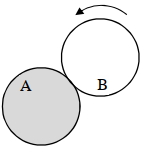

A flat surface of a thin uniform disk $A$ of radius $R$ is glued to a horizontal table. Another thin uniform disk $B$ of mass $M$ and with the same radius $R$ rolls without slipping on the circumference of $A$, as shown in the figure. A flat surface of $B$ also lies on the plane of the table. The center of mass of $B$ has fixed angular speed $\omega$ about the vertical axis passing through the center of $A$. The angular momentum of $B$ is $n M \omega R^2$ with respect to the center of $A$. Which of the following is the value of $n$ ?
On a horizontal smooth surface a disc is placed at rest. Another disc of same mass is coming with impact parameter equal to its own radius. First disc is of radius $r$. What should be the radius of coming disc so that after collision first disc moves at an angle $45^o$ to the direction of motion of incoming disc : 
The frequency of a whistle of an engine is $600\, cycles/sec$ is moving with the speed of $30 \,m/sec$ towards an observer. The apparent frequency will be .... $cps$ (velocity of sound $= 330 \,m/s$)
Consider two sound sources $S_1$ and $s_2$ having same frequency $100\,\,Hz$ and the observer $O$ located between them as shown in the fig. All the three are moving with same velocity in same direction. The beat frequency of the observer is .... $Hz$
A man throws balls with the same speed vertically upwards one after the other at an interval of $2\, seconds$. What should be the speed of the throw so that more than two balls are in the sky at any time (Given $g = 9.8\,m/{s^2}$)