MCQ
The mechanical equivalent of heat:
  • A
    Has the same dimension as heat.
  • B
    Has the same dimension as work.
  • C
    Has the same dimension as energy.
  • Is dimensionless.

Answer

Correct option: D.
Is dimensionless.
If the mechanical work done (W) produces the same temperature change as heat (H), then the mechanical equivalent of heat (J) is equal to $\frac{\text{W}}{\text{H}}.$ Thus,
$\text{J}=\frac{\text{W}}{\text{H}}$
Since the unit of work and heat is the same, mechanical equivalent of heat is dimensionless.

Need a full question paper?

Generate a complete, print-ready paper with questions like this in minutes — across 16+ boards, with answer keys.
Start Generating Free

Similar questions

A stone is dropped in a well which is $19.6\,m$ deep. Echo sound is heard after $2.06\, sec$ (after dropping) then the velocity of sound is .... $m/sec$
In an elastic collision of two particles the following is conserved
If a small orifice is made at a height of $0.25\, m$ from the ground, the horizontal range of water stream will be, (in $cm$)
A sphere of mass M and radius R is falling in a viscous fluid. The terminal velocity attained by the falling object will be proportional to
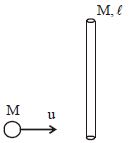
A rod of mass $M$ and length $l$ is at rest on plane horizontal smooth surface. A particle of same mass $M$ strike one end with velocity $u$ perpendicular to rod, elastically. Now just after collision what is the kinetic energy of upper half part of rod.
A wave going in a solid.
  1. Must be longitudinal
  2. May be longitudinal
  3. Must be transverse
  4. May be transverse.
A rope ladder with a length $l$ carrying a man with a mass $m$ at its end is attached to the basket of balloon with a mass $M.$ The entire system is in equilibrium in the air. As the man climbs up to the end of the ladder into the balloon, the balloon descends by a height $h.$ Then the potential energy of the man
A ball is rolled off the edge of a horizontal table at a speed of $4\, m/second$. It hits the ground after $0.4\, second$. Which statement given below is true
Velocity $-$ time graph of a body with uniform velocity is a straight line:
A particle moves in the $xy$ -plane with velocity $u_x = 8t -2$ and $u_y = 2$. If it passes through  the point $(14, 4)$ at $t = 2\, s$, the equation of its path is