MCQ
The minimum distance between an object and its real image formed by a convex lens is
  • A
    $2 f$
  • $4 f$
  • C
    $f$
  • D
    zero

Answer

Correct option: B.
$4 f$
b
Let the between object and real image be $d$.

Let the distance of object from the lens is $x$

So the distance of image and lens be $d - x$

Using the lens equation :

$\frac{1}{f}=\frac{1}{v}-\frac{1}{u}$

$\frac{1}{f}=\frac{1}{d-x}-\frac{1}{-d}$

$x =\frac{ d \pm \sqrt{ d ^2-4 fd }}{2}$

So for real $x$

$\sqrt{ d ^2-4 fd } \geq 0$

So $d \geq 4 f$

So minimum distance between object and image is $4 f$.

Need a full question paper?

Generate a complete, print-ready paper with questions like this in minutes — across 16+ boards, with answer keys.

Start Generating Free

Similar questions

The diameter of aperture of a plano-convex lens is $6 \,cm$ and its maximum thickness is $3 \,mm$. If the velocity of light in the material of the lens is $2 \times 10^8 \,m / s$, its focal length is ........ $cm$
Two capacitors each of capacity $2\,\mu F$ are connected in parallel. This system is connected in series with a third capacitor of $12\,\mu F$ capacity. The equivalent capacity of the system will be......$\mu F$
The magnetic field is uniform for $y>0$ and points into the plane. The magnetic field is uniform and points out of the plane for $y<0$. A proton denoted by filled circle leaves $y=0$ in the $-y$-direction with some speed as shown below.Which of the following best denotes the trajectory of the proton?
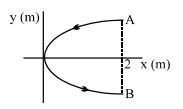
A conducting wire bent in the form of a parabola $y^2 = 2x$ carries a current $i = 2 A$ as shown in figure. This wire is placed in a uniform magnetic field $\vec B =  - 4\,\hat k$ $Tesla$. The magnetic force on the wire is (in newton)
The diagram shows a small bead of mass $m$ carrying charge $q$. The bead can freely move on the smooth fixed ring placed on a smooth horizontal plane. In the same plane a charge $+Q$ has also been fixed as shown. The potential atthe point $P$ due to $+Q$ is $V$. The velocity with which the bead should projected from the point $P$ so that it can complete a circle should be greater than
Consider the following statements $A$ and $B$ and identify the correct choice of the given answers

The potential barrier of a $ PN$junction lies between$ 0.1$ to $0.3\, V$ approximately

A zener diode is always connected in reverse bias
Size of nucleus is of the order of
The diffraction effect can be observed in
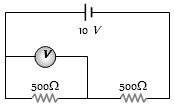
A voltmeter of resistance $1000\,\Omega$ is connected across a resistance of $500\, \Omega$ in the given circuit. What will be the reading of voltmeter .............. $V$
A hole is :