MCQ
The minimum distance between the object and its real image for concave mirror is
  • A
    $f$
  • B
    $2f$
  • C
    $4f$
  • $Zero$

Answer

Correct option: D.
$Zero$
d
( d)When object is kept at centre of curvature. It’s real image is also formed at centre of curvature.

Need a full question paper?

Generate a complete, print-ready paper with questions like this in minutes — across 16+ boards, with answer keys.
Start Generating Free

Similar questions

An energy source will supply a constant current into the load if its internal resistance is
$A$ bird is flying $3\, m$ above the surface of water. If the bird is diving vertically down with speed $= 6\, m/s$, his apparent velocity as seen by a stationary fish underwater is $m/s$
For an isotropic medium $B$, $\mu$,$ H $ and $M$  are related as (where $B,\,\,{\mu _0},\,\,H$ and M have their usual meaning in the context of magnetic material
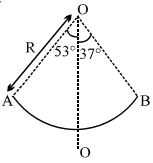
$A$ section of fixed smooth circular track of radius $R$ in vertical plane is shown in the figure. $A$ block is released from position $A$ and leaves the track at $B$. The radius of curvature of its trajectory when it just leaves the track at $B$ is:
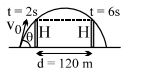
A projectile crosses two walls of equal height $H$ symmetrically as shown The maximum height of the projectile is  ........ $m$
This question has Statement $1$ and Statement $2.$ Of the four choices given after the Statements, choose the one that best describes the two Statements.

Statement $1 :$ The possibility of an electric bulb fusing is higher at the time of switching $ON.$

Statement $2:$ Resistance of an electric bulb when it is not lit up is much smaller than when it is lit up.

A cell sends a current through a resistance $R$ for time $t$. Now the same cell sends current through another resistance $r$ for the same time. If same amount of heat is developed in both the resistance, then the internal resistance of cell is
Sinusoidal carrier voltage of frequency $1.5 \,MHz$ and amplitude $50\, V$ is amplitude modulated by sinusoidal voltage of frequency $10\, kHz$ producing $50\% $ modulation. The lower and upper side-band frequencies in $kHz$ are
When a metallic surface is illuminated with light of wavelength $\lambda$, the stopping potential is $x$ volt. When the same surface is illuminated by light of wavelength $2 \lambda$, the stopping potential is $\frac{x}{3}$. Threshold wavelength for the metallic surface is ..........
Two forces $P + Q$ and $P -Q$ make angle $2 \alpha$ with each other and their  resultant make $\theta$ angle with bisector of angle between them. Then :