MCQ
The minimum energy required to remove an electron is called:
- AStopping potential
- BKinetic energy
- CWork function
- DNone of these
Explanation:
The minimum energy required to remove an electron is called is work funtion.
Generate a complete, print-ready paper with questions like this in minutes — across 16+ boards, with answer keys.
Which of the following are suitable for the fusion process
|
(a) Heavy nuclei |
(b) Light nuclei |
(c) Atom bomb |
(d) Radioactive decay |
The energy of a photon is E = hv and the momentum of photon p =  , then the velocity of photon will be
|
(a) E/p |
(b) Ep |
(c) |
(d) 3 |
When a glass rod is rubbed with silk, it
|
(a) Gains electrons from silk |
(b) Gives electrons to silk |
|
(c) Gains protons from silk |
(d) Gives protons to silk |
Assertion : X-rays cannot be diffracted by means of grating.
Reason : X-rays does not obey Bragg's law.
|
(a) If both assertion and reason are true and the reason is the correct explanation of the assertion. |
|
(b) If both assertion and reason are true but reason is not the correct explanation of the assertion. |
|
(c) If assertion is true but reason is false. |
|
(d) If the assertion and reason both are false. |
The decay constant of a radioactive element is 0.01 per second. Its half life period is
|
(a) 693 sec |
(b) 6.93 sec |
(c) 0.693 sec |
(d) 69.3 sec |
The particles which can be added to the nucleus of an atom without changing its chemical properties are called
|
(a) Electrons |
(b) Protons |
(c) Neutrons |
(d) None of the above |
The count rate of 10g of radioactive material was measured at different times and this has been shown in the figure. The half life of material and the total counts (approximately) in the first half life period, respectively are
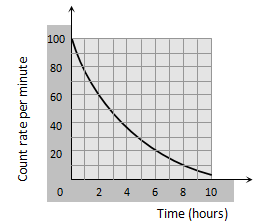
|
(a) 4h, 9000 |
(b) 3h, 14000 |
(c) 3h, 235 |
(d) 3h, 50 |

