MCQ
The minimum value of $\text{x}\log_{\text{e}}\text{x}$ is equal to :
  • A
    $\text{e}$
  • B
    $\frac{1}{\text{e}}$
  • $\frac{-1}{\text{e}}$
  • D
    $\text{2}{\text{e}}$

Answer

Correct option: C.
$\frac{-1}{\text{e}}$
Here, $\text{f}(\text{x})=\text{x}\log_{\text{e}}\text{x}$lmplies that $\text{f}'(\text{x})=\log_{\text{e}}\text{x}+1$
For a local maxima or a local minima, we must have f'(x) = 0
lmplies that $\log_{\text{e}}\text{x}+1=0$
lmplies that $\log_\text{e}\text{x}=-1$
lmplies that $\text{x}=\text{e}^{-1}$
Now, $\text{f}''(\text{x})=\frac{1}{\text{x}}$
lmplies that $\text{f}''(\text{e}^{-1})=\text{e}>0$
Threrfore, $\text{f}(\text{e}^{-1})$ is a local minima.
Hence, the minimum value of $\text{f}(\text{x})=\text{f}(\text{e}^{-1})$
lmplies that $\text{e}^{-1}\log_\text{e}(\text{e}^{-1})=-\text{e}^{-1}=\frac{-1}{\text{e}}$

Need a full question paper?

Generate a complete, print-ready paper with questions like this in minutes — across 16+ boards, with answer keys.
Start Generating Free

Similar questions

Let $\vec{a}, \vec{b}, \vec{c}$ be three mutually perpendicular vectors of the same magnitude and equally inclined at an angle $\theta$, with the vector $\vec{a}+\vec{b}+\vec{c}$. Then $36 \cos ^{2} 2 \theta$ is equal to $.....$
If $\theta$ is the angle between the vectors $2\hat{\text{i}}-2\hat{\text{j}}+4\hat{\text{k}}$ and $3\hat{\text{i}}+\hat{\text{j}}+2\hat{\text{k}},$ then $\sin\theta=$
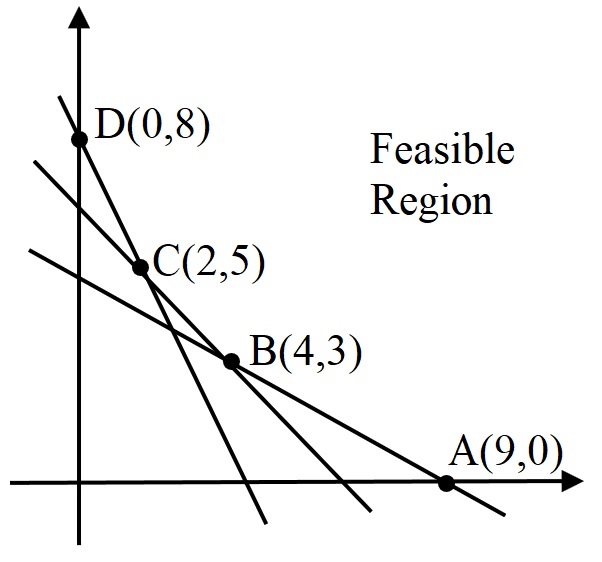
The feasible region for an $\text{LPP}$ is shown shaded in the following figure. Minimum of $Z = 4x + 3y$ occurs at the point.
Let $f$ be a real valued function, defined on $R -\{-1,1\}$ and given by

$f(x)=3 \log _{e}\left|\frac{x-1}{x+1}\right|-\frac{2}{x-1}$

Then in which of the following intervals, function $f ( x )$ is increasing?

Let $f _1: R \rightarrow R , f _2:[0, \infty) \rightarrow R , f _3: R \rightarrow R$ and $f _4: R \rightarrow[0, \infty)$ be defined by

$f_1(x)=\left\{\begin{array}{lll}|x| & \text { if } & x<0, \\ e^x & \text { if } & x \geq 0 ;\end{array}\right.$

$f_2(x)=x^2$

$f_3(x)=\left\{\begin{array}{ccc}\sin x & \text { if } & x < 0, \\ x & \text { if } & x \geq 0\end{array}\right.$ and

$f_4(x)=\left\{\begin{array}{ccc}f_2\left(f_1(x)\right) & \text { if } & x < 0, \\ f_2\left(f_1(x)\right)-1 & \text { if } & x \geq 0\end{array}\right.$

List $I$ List $II$
$P.$ $ f_4$ is $1.$ onto but not one-one
$Q.$ $f_3$ is $2.$ neither continuous nor one-one
$R.$ $f _2 \circ f _1$ is $3.$ differentiable but not one-one
$S.$ $ f_2$ is $4.$ continuous and one-one

Codes: $ \quad P \quad Q \quad R \quad S $

Choose the correct answer from the given four options. The matrix $\begin{bmatrix}1&0&0\\0&2&0\\0&0&4\end{bmatrix}$ is a:
A man takes a step forward with probability $0.4$ and backward with probability $0.6.$ The probability that at the end of eleven steps he is one step away from the starting point is
Let $p$ denotes the probability that a man aged $x$ years will die in a year. The probability that out of $n$ men ${A_1},\,{A_2},\,{A_3}......{A_n}$each aged $x,\,\,{A_1}$will die in a year and will be the first to die, is
If $f(x)$ satisfies the relation $f\left( {\frac{{5x - 3y}}{2}} \right) = \frac{{5f(x) - 3f(y)}}{2}\forall x,y\, \in \,R$ and $f(0)=1, f'(0)=2$ then the period of $sin(f(x))$ is 
Choose the correct answer from the given four options.
If A and B are matrices of same order, then (AB′ – BA′) is a: