MCQ
The minimum wavelength of the $X-$ rays produced by electrons accelerated through a potential difference of $V$ volts is directly proportional to
  • A
    $\sqrt V $
  • B
    ${V^2}$
  • C
    $1/\sqrt V $
  • $1/V$

Answer

Correct option: D.
$1/V$
d
$h{\nu _{\max }} = eV$

$ \Rightarrow \,\frac{{hc}}{{{\lambda _{\min }}}} = eV$

$\therefore \,\,{\lambda _{\min }} \propto \frac{1}{V}$

Need a full question paper?

Generate a complete, print-ready paper with questions like this in minutes — across 16+ boards, with answer keys.
Start Generating Free

Similar questions

A current of $i$ ampere is flowing in an equilateral triangle of side $a$. The magnetic induction at the centroid will be
Of the two bulbs in a house hold circuit, one glows brighter than the other, Which of the two bulbs has a large resistance?
Kinetic energy of emitted cathode rays is dependent on
When the current through the electromagnet of a relay reaches a particular value:
In Young's double slit experiment the slits are $0.5\, mm$ apart and the interference is observed on a screen at a distance of $100\, cm$ from the slit. It is found that the $9^{th}$ bright fringe is at a distance of $7.5\, mm$ from the second dark fringe from the centre of the fringe pattern. The wavelength of the light used is.....$\mathop A\limits^o $
In a wave, the path difference corresponding to a phase difference of f is 
A long straight wire of circular cross-section (radius $a$) is carrying steady current $I$. The current $I$ is uniformly distributed across this cross-section. The magnetic field is
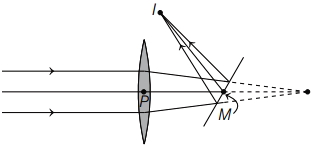
A horizontal parallel beam of light passes through a vertical convex lens of focal length $20 \,cm$ and is then reflected by a tilted plane mirror, so that it converges to a point $I$. The distance $P I$ is $10 \,cm$. $M$ is a point at which the axis of the lens intersects the mirror. The distance $P M$ is $10 \,cm$. The angle which the mirror makes with the horizontal is
A charge particle is free to move in an electric field. It will travel
The value of internal resistance of an ideal cell is $\Omega$