MCQ
The minimum wavelength of $X$-rays produced by an electron accelerated through a potential difference of $V_{\text {volts }}$ is proportional to :
  • A
    $V^2$
  • B
    $\sqrt{V}$
  • $\frac{1}{V}$
  • D
    $\frac{1}{\sqrt{V}}$

Answer

Correct option: C.
$\frac{1}{V}$
c
Minimum wavelength of $X-$Rays is

$\lambda_{\min }=\frac{ hC }{ eV }$

hence $\lambda_{\min } \propto \frac{1}{V}$

So Ans. $\left(\frac{1}{ V }\right)$

Need a full question paper?

Generate a complete, print-ready paper with questions like this in minutes — across 16+ boards, with answer keys.
Start Generating Free

Similar questions

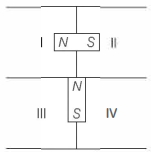
Two identical bar magnets are held perpendicular to each other with a certain separation, as shown below. The area around the magnets is divided into four zones. Given that there is a neutral point it is located in
The potential at a point due to an electric dipole will be maximum and minimum when the angles between the axis of the dipole and the line joining the point to the dipole are respectively
The electrostatic potential inside a charged spherical ball is given by : $V = b -ar^2$, where  $r$ is the distance from the centre ; $a$ and $b$ are constants. Then, the charge density inside the ball is :
Due to Doppler effect, the shift in wavelength observed is $0.1\;\mathring A $, for a star producing a wavelength $6000\;\mathring A $. The velocity of recession of the star will be ....... $km/sec$
Sum of the two binary numbers ${(1000010)_2}$ and ${(11011)_2}$ is
Two identical thin rings, each of radius a meter, are coaxially placed at a distance $R$ meter apart. If $Q_1$ coulomb and $Q _2$ coulomb are respectively the charges uniformly spread on the two rings, the work done in moving a charge q coulomb from the centre of one ring to that of the other is:
For a specific wavelength $670 \; nm$ of light coming from a galaxy moving with velocity $v$, the observed wavelength is $670.7 \; nm$. The value of $v$ is ............
Which one of the following spherical lenses does not exhibit dispersion? The radii of curvature of the surfaces of the lenses are as given in the diagrams
The dependence of drift velocity on applied electric field $E$ is:
An orbital electron in the ground state of hydrogen has magnetic moment $\mu_1$.  This orbital electron is excited to $3^{rd}$ excited state by some energy transfer to the hydrogen atom. The new magnetic moment of the electron is $\mu_2$ , then