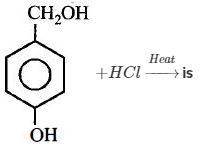
MCQ
The mixture which shows positive deviation from Raoult's law is
- AChloroethane $+$ Bromoethane
- ✓Ethanol $+$ Acetone
- CBenzene $+$ Toluene
- DAcetone $+$ Chloroform
Generate a complete, print-ready paper with questions like this in minutes — across 16+ boards, with answer keys.
| column $(I)$ | column $(II)$ | ||
| $(A)$ | Kohlraush law | $(i)$ | $\Lambda _{eq}^o = \Lambda _c^o + \Lambda _a^o$ |
| $(B)$ | Molar Conductivity |
$(ii)$ | $\Lambda _m = \frac{{K \times 1000}}{M}$ |
| $(C)$ | Degree of Dissociation |
$(iii)$ | $\alpha = {\Lambda _m}/\Lambda _m^o$ |
| $(D)$ | Dissociation Constant |
$(iv)$ | ${k_a} = C{\alpha ^2}/1 - \alpha $ |
| Column $I$ | Column $II$ |
| $(A)$ $\mathrm{C}_6 \mathrm{H}_5 \mathrm{CHO}$ | $(p)$ gives precipitate with $2, 4$-dinitrophenylhydrazine |
| $(B)$ $\mathrm{CH}_3 \mathrm{C} \equiv \mathrm{CH}$ | $(q)$ gives precipitate with $\mathrm{AgNO}_3$ |
| $(C)$ $\mathrm{CN}^{-}$ | $(r)$ is a nucleophile |
| $(D)$ $\mathrm{I}^{-}$ | $(s)$ is involved in cyanohydrin formation |