MCQ
The molality of $90\%$ ${H_2}S{O_4}$ solution is [density $=1.8\,gm/ml$ ]
- A$1.8$
- B$48.4$
- ✓$9.18$
- D$94.6$
Weight of one litre of solution $ = 1800\,gm$
$\therefore $ Weight of ${H_2}S{O_4}$ in the solution$ = \frac{{1800 \times 90}}{{100}}$$=162\,gm$
$\therefore $ Weight of solvent $ = 1800 - 1620 = 180\,gm$
$\therefore $ Molality $ = \frac{{1620}}{{98}} \times \frac{{100}}{{180}} = 9.18$
Generate a complete, print-ready paper with questions like this in minutes — across 16+ boards, with answer keys.
The following inferences are made
$(A)$ $\mathrm{X}$ has higher intermolecular interactions compared to $Y$.
$(B)$ $\mathrm{X}$ has lower intermolecular interactions compared to $Y$.
$(C)$ $\mathrm{Z}$ has lower intermolecular interactions compared to $Y.$
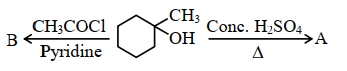
The correct inference(s) is/are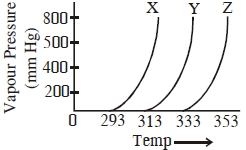
$Y$ is
$(I)\, Co(III)$ is stabilised in presence of weak field ligands, while $Co(II)$ is stabilised in presence of strong field ligand.
$(II)$ Four coordinated complexes of $Pd(II)$ and $Pt(II)$ are diamagnetic and square planar.
$(III)\,[Ni (CN)_4]^{4-}$ ion and $[Ni (CO)_4]$ are diamagnetic tetrahedral and square planar respectively.
$(IV)\,Ni^{2+}$ ion does not form inner orbital octahedral complexes.