MCQ
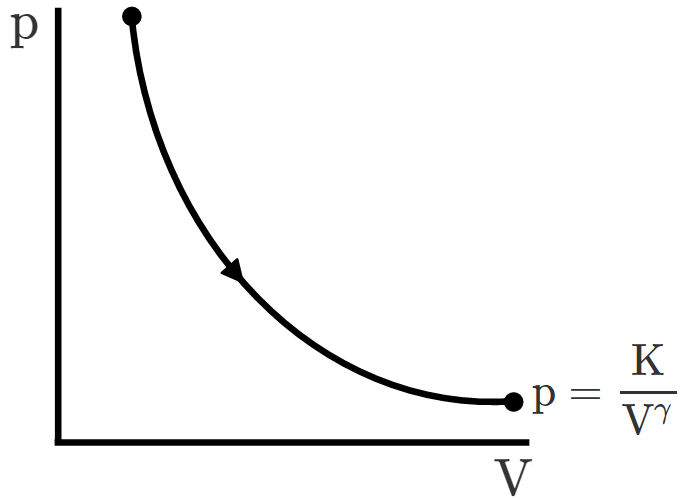
The molar heat capacity for the process shown in the figure is:
  • A
    $C=C_p$
  • B
    $C=C_v$
  • C
    $C>C_v$
  • $C=0$

Answer

Correct option: D.
$C=0$
The defined process is,
$\text{p}=\frac{\text{k}}{\text{V}_\text{g}}$
$\Rightarrow\text{pV}_\text{g}=\text{k}$
Such that the process is adiabatic in which there's no heat supplied to the system,
i.e. $Q = 0.$ Molar heat capacity is the amount of heat supplied to the system per mole to produce a degree change in temperature.
Also, in an adiabatic process, no heat exchange is allowed.
So, molar heat capacity equals zero, i.e. $C = 0.$

Need a full question paper?

Generate a complete, print-ready paper with questions like this in minutes — across 16+ boards, with answer keys.

Start Generating Free

Similar questions

When a tuning fork of frequency $341$ is sounded with another tuning fork, six beats per second are heard. When the second tuning fork is loaded with wax and sounded with the first tuning fork, the number of beats is two per second. The natural frequency of the second tuning fork is
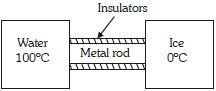
An insulated container is filled with ice at $0\,^oC$ , and another container is filled with water that is continuously boiling at $100\,^oC$ . In series of experiments, the containers are connected by various thick metal rods that pass through the walls of container as shown in the figure

In the experiment $I$ : a copper rod is used and all ice melts in $20$ minutes.

In the experiment $II$ : a steel rod of identical dimensions is used and all ice melts in $80$ minutes.

In the experiment $III$ : both the rods are used in series and all ice melts in $t_{10}$ minutes.

In the experiment $IV$ : both rods are used in parallel and all ice melts in $t_{20}$ minutes.
For the given fig. find the speed of block $A$ when $\theta  = {60^o}$
A small ball is projected up a smooth inclined plane with an initial speed of $10\ m/s$ along the direction at $30^o $ to the bottom edge of the slope. It returns to the edge after $2\, s$. The ball is in contact with the inclined plane throughout the process. ....... $^o$ is the inclination angle of the plane.
A mixture of $2\, moles$ of helium gas (atomic mass $= 4\, u$), and $1\, mole$ of argon gas (atomic mass $= 40\, u$) is kept at $300\, K$ in a container. The ratio of their rms speeds $\left[ {\frac{{{V_{rms}}{\rm{(helium)}}}}{{{V_{rms}}{\rm{(argon)}}}}} \right]$, is close to
Orbital velocity of earth's satellite near the surface is $7 \,km/s$. When the radius of the orbit is $4$ times than that of earth's radius, then orbital velocity in that orbit is ......... $km/sec$
If a particle takes $t$ second less and acquires a velocity of $v \ ms^{^{-1}}$ more in falling through the same distance (starting from rest) on two planets where the accelerations due to gravity are $2 \,\, g$ and $8 \,\,g$ respectively then $v=$
Two unequal masses are connected on two sides of light string passing over a light and smooth pulley as shown in the figure. The system is released from rest. The larger mass is stopped $1\, sec$ after the system is set into motion and then released. The time elapsed before the string is tight again $(g = 10\, m/sec^2)$
The metallic bob of simple pendulum has the relative density $5$. The time period of this pendulum is $10\,s$. If the metallic bob is immersed in water, then the new time period becomes $5 \sqrt{ x } s$. The value of $x$ will be.
A force $F$ is needed to break a copper wire having radius $R.$ The force needed to break a copper wire of radius $2R$ will be