MCQ
The moment of inertia of an object does not depend on:
  • A
    mass
  • angular velocity
  • C
    mass distribution
  • D
    the axis of rotation

Answer

Correct option: B.
angular velocity
B

Need a full question paper?

Generate a complete, print-ready paper with questions like this in minutes — across 16+ boards, with answer keys.

Start Generating Free

Similar questions

A solid sphere is rotating freely about its symmetry axis in free space. The radius of the sphere is increased keeping its mass same. Which of the following physical quantities would remain constant for the sphere $?$ 
Two satellites $A$ and $B$ of masses $200\, kg$ and $400\, kg$ are revolving round the earth at height of $600\, km$ and $1600\, km$ respectively. If $T _{ A }$ and $T _{ B }$ are the time periods of $A$ and $B$ respectively then the value of $T _{ B }- T _{ A }$

[Given : radius of earth $=6400\, km$, mass of earth $=6 \times 10^{24}\, kg$ ]

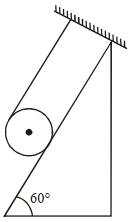
A solid cylinder of mass $m$ is wrapped with an inextensible light string and, is placed on a rough inclined plane as shown in the figure. The frictional force acting between the cylinder and the inclined plane is:

[The coefficient of static friction, $\mu_{ s },$ is $\left.0.4\right]$
A wire of length $2\, m$ is made from $10\;c{m^3}$ of copper. A force $F$ is applied so that its length increases by $2\, mm.$ Another wire of length 8 m is made from the same volume of copper. If the force $F$ is applied to it, its length will increase by......... $cm$
An electron starting from rest has a velocity that increases linearly with the time that is $v = kt,$ where $k = 2m/{\sec ^2}$. The distance travelled in the first $3 \,seconds$ will be...........$m$
A rubber pipe of density $1.5 \times {10^3}\,N/{m^2}$ and Young's modulus $5 \times {10^6}\,N/{m^2}$ is suspended from the roof. The length of the pipe is $8 \,m$. What will be the change in length due to its own weight
Due to capillary action, a liquid will rise in a tube, if the angle of contact is
The kerosene oil rises up in the wick of a lamp ...........
The value of maximum possible amplitude in the case of forced oscillations when driving frequency is close to natural frequency is
Find angle between $\vec A = 3\hat i - \hat j + 4\hat k$ and $Z-$ axis