MCQ
The most commonly used material for making transistor is
  • A
    Copper
  • Silicon
  • C
    Ebonite
  • D
    Silver

Answer

Correct option: B.
Silicon
b
Most transistors are made from very pure silicon, and some from germanium, but certain other semiconductor materials are sometimes used. A transistor may have only one kind of charge carrier, in a field-effect transistor, or may have two kinds of charge carriers in bipolar junction transistor devices.

Need a full question paper?

Generate a complete, print-ready paper with questions like this in minutes — across 16+ boards, with answer keys.

Start Generating Free

Similar questions

A slab of dielectric constant $K$ has the same crosssectional area as the plates of a parallel plate capacitor and thickness $\frac{3}{4}\,d$, where $d$ is the separation of the plates. The capacitance of the capacitor when the slab is inserted between the plates will be.(Given $C _{0}=$ capacitance of capacitor with air as medium between plates.)
The current sensitivity of a moving coil galvanometer can be increased by
The energy released in the fusion of $2 \mathrm{~kg}$ of hydrogen deep in the sun is $\mathrm{E}_{\mathrm{H}}$ and the energy released in the fission of $2 \mathrm{~kg}$ of ${ }^{235} \mathrm{U}$ is $E_U$. The ratio $\frac{E_H}{E_U}$ is approximately :

(Consider the fusion reaction as $4{ }_1^1 \mathrm{H}+2 \mathrm{e}^{-} \rightarrow{ }_2^4 \mathrm{He}+2 \mathrm{v}+6 \gamma+26.7 \mathrm{MeV}$, energy released in the fission reaction of ${ }^{235} \mathrm{U}$ is $200 \mathrm{MeV}$ per fission nucleus and $\mathrm{N}_{\mathrm{A}}=6.023 \times 10^{23}$ )
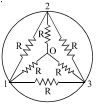
Inside $a$ super conducting ring six identical resistors each of resistance $R$ are connected as shown in figure. The equivalent resistance $(s)$
After charging a capacitor the battery is removed. Now by placing a dielectric slab between the plates :- 
Solar spectrum is an example of:
Given a point source of light, which of the following can produce a parallel beam of light
In an electron gun the control grid is given a negative potential relative to cathode in order to:
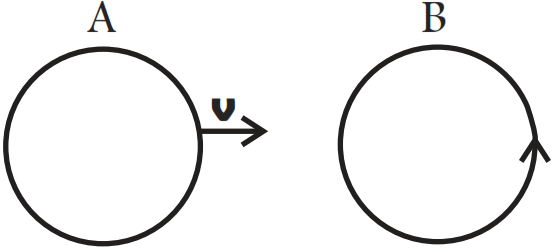
There are two coils $A$ and $B$ as shown in Fig. A current starts flowing in $B$ as shown, when $A$ is moved towards $B$ and stops when $A$ stops moving. The current in $A$ is counterclockwise. $B$ is kept stationary when $A$ moves. We can infer that:
Consider two thin identical conducting wires covered with very thin insulating material. One of the wires is bent into a loop and produces magnetic field $B_1,$ at its centre when a current $I$ passes through it.The second wire is bent into a coil with  three identical loops adjacent to each other and produces magnetic field $B_2$ at the centre of the loops when current $I/3$ passes through it. The ratio $B_1 : B_2$ is