MCQ
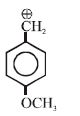
The most stable carbocation is
- ✓
- B
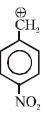
- C
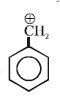
- D
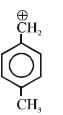
Generate a complete, print-ready paper with questions like this in minutes — across 16+ boards, with answer keys.
$\begin{array}{*{20}{c}}
{OH\,\,\,\,\,\,\,\,\,\,\,\,\,\,\,\,\,\,\,\,\,\,} \\
{|\,\,\,\,\,\,\,\,\,\,\,\,\,\,\,\,\,\,\,\,\,\,\,\,\,\,\,} \\
{C{H_3}CHC{H_2}C{H_2}N{H_2}}
\end{array}$ $\xrightarrow[{triethyla\min e}]{{ethyl\,formate\,\left( {1\,equiv} \right)}}$
$\Delta {H^o}\, = \, +234.1\,\,kJ$
$C(s)\, + {O_2}(g)\, \to \,\,C{O_2}(g)$
Use these equation and $\Delta H^o$ value to calculate $\Delta H^o$ for this reaction:
$4Fe(s) + 3O_2(g) \to 2Fe_2O_3(s)$
.....$kJ$
$(I)$ They have high melting points, higher than those of pure metals
$(II)$ They are very hard
$(III)$ They retain metallic conductivity
$(IV)$ They are chemically more reactive than the pure metals
$(I)$ $\begin{array}{*{20}{c}}
{{{(C{H_3})}_3}Si - NB{H_2}} \\
{\,\,\,\,\,\,\,\,\,\,\,\,\,\,\,\,\,\,|} \\
{\,\,\,\,\,\,\,\,\,\,\,\,\,\,\,\,\,\,\,\,\,\,\,\,\,\,\,\,\,\,\,\,\,\,Si{{(C{H_3})}_3}}
\end{array}$ $(II)$ $\begin{array}{*{20}{c}}
{{{(C{H_3})}_3}C - NB{H_2}} \\
{\,\,\,\,\,\,\,\,\,\,\,\,\,\,\,\,\,|} \\
{\,\,\,\,\,\,\,\,\,\,\,\,\,\,\,\,\,\,\,\,\,\,\,\,\,\,\,\,\,\,\,\,\,\,\,C{{(C{H_3})}_3}}
\end{array}$