Question
The motion of a torsional pendulum is:
  1. Periodic.
  2. Oscillatory.
  3. Simple harmonic.
  4. Angular simple harmonic.

Answer

  1. Periodic.
  1. Oscillatory.
  1. Angular simple harmonic.

Explanation:

Because it completes one oscillation in a fixed interval of time and the oscillations are in terms of rotation of the body through some angle.

Need a full question paper?

Generate a complete, print-ready paper with questions like this in minutes — across 16+ boards, with answer keys.

Start Generating Free

Similar questions

If a charged particle moves unaccelerated in a region containing electric and magnetic fields,
  1. $\overrightarrow{\text{E}}$ must be perpendicular to $\overrightarrow{\text{B}}$
  2. $\overrightarrow{\text{V}}$ must be perpendicular to $\overrightarrow{\text{E}}$
  3. $\overrightarrow{\text{V}}$ must be perpendicular to $\overrightarrow{\text{B}}$
  4. E must be equal to vB.

A plane mirror is approaching you at a speed of 10 cm/sec You can see your image in it. At what speed will your image approach you

(a) 10 cm/sec

(b) 5 cm/sec

(c) 20 cm/sec

(d) 15 cm/sec

The dielectric constant K of an insulator will be-
Water enters through end A with a speed v1 and leaves through end B with a speed v2 of a cylindrical tube AB. The tube is always completely filled with water. In case I the tube is horizontal, in case II it is vertical with the end A upward and in case III it is vertical with the end B upward. We have v1 = v2 for
  1. Case I.
  2. Case II.
  3. Case III.
  4. Each case.
The visible region of hydrogen spectrum was first studied by:
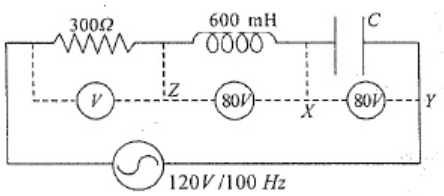
In above circuit, what is the potential drop across ZY?
Image

What type of modulation is employed in India for radio transmission

(a) Amplitude modulation

(b) Frequency modulation

(c) Pulse modulation

(d) None of these

A house is served by 220 V supply line in a circuit protected by a 9 ampere fuse. The maximum number of 60 W lamps in parallel that can be turned on, is

(a) 44

(b) 20

(c) 22

(d) 33

Which of the following (referred to a spherical mirror) do (does) not depend on whether the rays are paraxial or not?
  1. Pole.
  2. Focus.
  3. Radius of curvature.
  4. Principal axis.

A straight wire carrying current i is turned into a circular loop. If the magnitude of magnetic moment associated with it in M.K.S. unit is M, the length of wire will be

(a) 4πiM

(b)  

(c)    

(d)