MCQ
The naturally occurring amino acid that contains only one basic functional group in its chemical structure is
- Aarginine
- Blysine
- ✓asparagine
- Dhistidine
Others are basic amino acid with more than one basic functional group.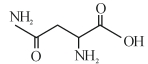
Generate a complete, print-ready paper with questions like this in minutes — across 16+ boards, with answer keys.
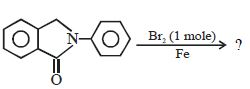
Where $A$ is $PCl^+_4$ while $B$ is $PCl^-_ 6$
Which of the following statement is INCORRECT :
$(I)$ $B$ to $A$ involvement of number of $d-$orbital in hybridization increases
$(II)$ $A$ to $B$ precentage of $p-$character in $P-Cl$ bond increases
$(III) $ Number of covalent bond in $A$ and $B$ are same
$(IV)$ $B$ is product of Lewis acid-base interaction which is associated with super octet molecule only
| Leaving group | Conj. Acid $pK_a$ | $\%$ -yield of $2$-hexene | $\%$ -yield of $1$ -hexene |
| $X = I$ | $- 10$ | $81\%$ | $19\%$ |
| $X = Br$ | $-9$ | $72\%$ | $28\%$ |
| $X = Cl$ | $-7$ | $67\%$ | $33\%$ |
| $X = F$ | $3.2$ | $30\%$ | $70\%$ |
Which of the following statement is (are) true concerning this series of $E_2$ reactions ?