Question
The nature of electromagnetic wave is :-

Answer

Electromagnetic waves are transverse. The are moving with a certain phase velocity $v =\frac{\omega}{ k }$. Thus they are not stationary.

Need a full question paper?

Generate a complete, print-ready paper with questions like this in minutes — across 16+ boards, with answer keys.
Start Generating Free

Similar questions

When light travels from one medium to the other of which the refractive index is different, then which of the following will change
The kinetic energy of one gram molecule of a gas at normal temperature and pressure is $(R = 8.31\,J/mole - K)$
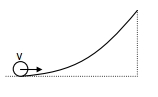
A small object of uniform density rolls up a curved surface with an initial velocity $v$. It reaches up to a maximum height of $\frac{3 \mathrm{v}^2}{4 \mathrm{~g}}$ with respect to the initial position. The object is
A source of sound $A$ emitting waves of frequency $1800\,Hz$ is falling towards ground with a terminal speed $v.$ The observer $B$ on the ground directly beneath the source receives waves of frequency $2150\,Hz.$ The source $A$ receives waves, reflected from ground of frequency nearly ..... $Hz$ (Speed of sound $= 343\,m/s$ )
If $\vec{E}$ and $\vec{B}$ are the electric and magnetic field vectors of electromagnetic waves, then the direction of propagation of the electromagnetic wave is along the direction of:
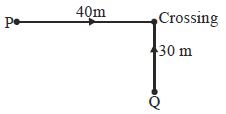
A car $P$ approaching a crossing at a speed of $10\, m/s$ sounds a horn of frequency $700\, Hz$ when $40\, m$ in front of the crossing. Speed of sound in air is $340\, m/s$. Another car $Q$ is at rest on a road which is perpendicular to the road on which car $P$ is reaching the crossing (see figure). The driver of car $Q$ hears the sound of the horn of car $P$ when he is $30\, m$ in front of the crossing. The apparent frequency heard by the driver of car $Q$ is .... $Hz$
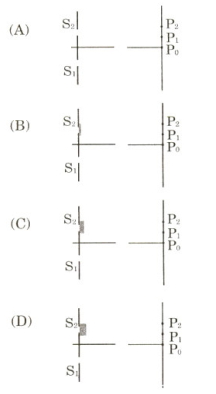
Column $I$ shows four situations of standard Young's double slit arrangement with the screen placed far away from the slits $S_1$ and $S_2$. In each of these cases $\mathrm{S}_1 \mathrm{P}_0=\mathrm{S}_2 \mathrm{P}_0, \mathrm{~S}_1 \mathrm{P}_1-\mathrm{S}_2 \mathrm{P}_1=\lambda / 4$ and $\mathrm{S}_1 \mathrm{P}_2-\mathrm{S}_2 \mathrm{P}_2=\lambda / 3$, where $\lambda$ is the wavelength of the light used. In the cases $\mathrm{B}, \mathrm{C}$ and $\mathrm{D}$, a transparent sheet of refractive index $\mu$ and thickness $t$ is pasted on slit $\mathrm{S}_2$. The thicknesses of the sheets are different in different cases. The phase difference between the light waves reaching a point $\mathrm{P}$ on the screen from the two slits is denoted by $\delta(\mathrm{P})$ and the intensity by $I(\mathrm{P})$. Match each situation given in Column $I$ with the statement$(s)$ in Column $II$ valid for that situation.

Column $I$ Column $II$
$(A)$ $Image$ $(p)$ $\delta\left(\mathrm{P}_0\right)=0$
$(B)$ $(\mu-1) t=\lambda / 4$ $Image$ $(q)$ $\delta\left(\mathrm{P}_1\right)=0$

$(C)$ $(\mu-1) t=\lambda / 2$ $Image$

$(r)$ $I\left(\mathrm{P}_1\right)=0$
$(D)$ $(\mu-1) t=3 \lambda / 4$ $Image$ $(s)$ $\left(\mathrm{P}_0\right)>I\left(\mathrm{P}_1\right)$
  $(t)$ $I\left(\mathrm{P}_2\right)>I\left(\mathrm{P}_1\right)$

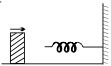
$A$ $1.0\, kg$ block collides with a horizontal weightless spring of force constant $2.75 Nm^{-1}$ as shown in figure. The block compresses the spring $4.0\, m$ from the rest position. If the coefficient of kinetic friction between the block and horizontal surface is $0.25$, the speed of the block at the instant of collision is ................. $\mathrm{m}/ \mathrm{s}^{-1}$
The function $(sin\,\omega t -cos\,\omega t)$ represents
When light of wavelength $300 \;nm$ (nanometer) falls on a photoelectric emitter, photoelectrons are liberated. For another emitter, however light of $600\; nm$ wavelength is sufficient for creating photoemission. What is the ratio of the work functions of the two emitters